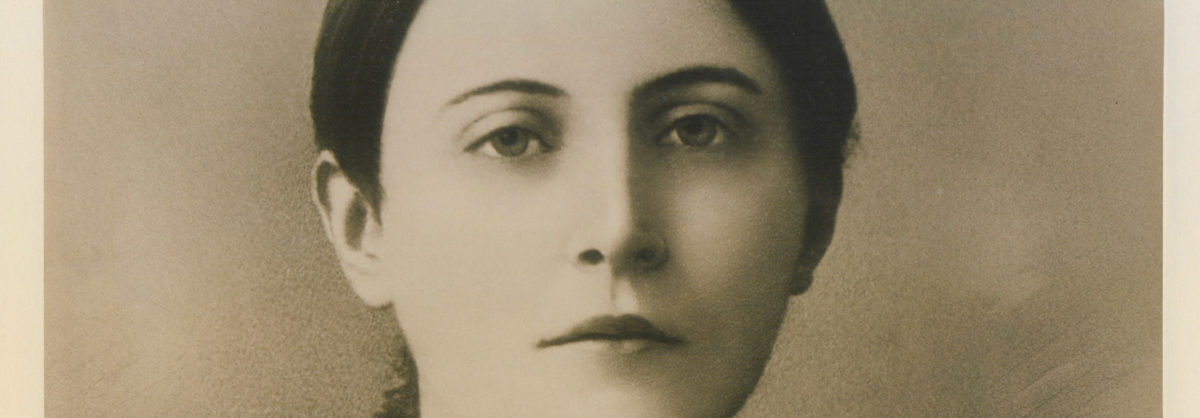

Gemma Galgani was a saint who longed to make others aware of the great mercy of our Lord. In her diary she wrote, “Let us run to Jesus, Heart of Love, Heart full of tenderness. Let us ask Jesus to give us the riches of His pure love—to breathe only for love, to live only for love."
Saint Gemma’s hope was that by encountering Christ’s mercy, people would turn from their sins and to the cross - the cross which Gemma spent most of her life meditating upon. She was no foreigner to suffering. In fact, suffering was such a defining experience of this young saint’s life that she became known as the “Daughter of the Passion” because of her profound union with Christ’s Passion.
Born in Camigliano, a small village near Lucca, Italy, on March 12, 1878, Gemma was the fifth of eight children. From a young age, she was an obedient child who had an earnest desire to be one with the Lord. Her mother arranged for her to receive the sacrament of Confirmation at the age of eight. Shortly after, her mother died. This would be the first of many painful moments in Gemma’s life. Not long after that, Gemma’s brother died and her father went bankrupt, leaving the Galgani family in extreme poverty.
Durante este tiempo, Gemma desarrolló una dolorosa enfermedad en la columna vertebral, lo que dificultó que su familia pudiera cuidar de ella. San Gabriel Possenti, un sacerdote pasionista italiano al que Gemma tenía gran devoción, se le apareció en una visión. Le dijo que le rezara una novena por su curación. El noveno día de la novena, tras una visión de Jesús, se curó milagrosamente.
After her cure, Gemma longed for nothing more than to become a Passionist nun, but due to her proclivity to illness, the religious order denied her request. Though this rejection inflicted more pain upon her young heart, Gemma surrendered her will to God’s will and trusted Him. She resolved to spend her life meditating upon the suffering of our Lord.
En 1899, a la edad de 21 años, Gemma recibió una manifestación externa del sufrimiento de Cristo - los santos estigmas. Los estigmas son una gracia concedida a alguien por la que lleva todas o algunas de las llagas de Cristo. Las llagas suelen coincidir con intensos sufrimientos físicos y espirituales, que conforman aún más al receptor con Cristo.
Gemma escribió lo siguiente sobre su primera experiencia con los estigmas, que tuvo lugar de jueves a sábado durante un año:
…I found myself before my heavenly Mother. At her right stood my guardian angel, who told me to make an act of contrition. When I had finished it my blessed Mother said to me “Daughter—In the name of Jesus, your sins are forgiven.” Then she added: “Jesus my Son loves you very much, and He wishes to give you a grace. Do you know how to make yourself worthy of it?” In my misery I did not know what to answer. She continued “I will be your Mother. Will you be a true daughter?” She then spread her mantle and covered me with it. . . At that moment Jesus appeared with all His wounds open, but blood no longer came out of those wounds. Rather, flames of fire issued forth from them and in an instant these flames came to touch my hands, my feet and my heart. I felt as if I would die. I fell to the floor, but my Mother supported me, keeping me covered in her mantle. I had to remain several hours in that position. Finally she kissed me on my forehead, and all vanished, and I found myself kneeling on the floor. But I still felt an intense pain in my hands, feet and heart. I arose to go to bed, and I then noticed that blood was flowing from those parts where I felt pain … The sufferings continued until 3pm on Friday afternoon, the solemnity of the Sacred Heart of Jesus.
Al cabo de un año de soportar los estigmas, Gema empezó a deteriorarse físicamente y a enfermar. Su consejero espiritual le dijo que debía rezar para ser aliviada de estos sufrimientos. Obedeció y sus oraciones fueron escuchadas. Los estigmas cesaron. En los lugares donde habían estado las heridas, quedaron marcas blancas.
En enero de 1903, Gemma contrajo tuberculosis, que sería la causa de su muerte. El 11 de abril de 1903 - Sábado Santo - Gemma’s suffering in this world ended and she entered into eternal peace.
Por muy diferentes que sean Santa Gemma Galgani y Santa Isabel Ana Seton, sus valores fundamentales y su espiritualidad son similares. Podemos meditar sobre tres valores particulares de estas dos santas para inspirar nuestra propia vida espiritual.
La necesidad de la misericordia de Dios
Like Gemma, Elizabeth Ann Seton was keenly aware of the cost of her own sins and she desired to grow in Christ-like virtue. Elizabeth wrote, “Solemnly in the presence of my Judge, I resolve through his grace, to remember my infirmity and my sin; to keep the door of my lips; to consider the cause of sorrow for sin in myself and [in] them whose souls are so dear to me as my own.”
Jesús no espera que seamos perfectos, pero sí que nos propongamos parecernos más a Él. Para ello, primero debemos reconocer nuestras faltas y ser conscientes de las consecuencias de nuestros actos. La indiferencia ante nuestros actos y nuestra fe nos separa del amor de Dios.
Dar todo a Jesús por María
Aunque sus vocaciones eran diferentes, Santa Gema y Santa Isabel Ana Seton tenían una devoción apasionada por estar totalmente unidas a Jesús. - particularmente a través del corazón de María.
Though Gemma could not love Jesus behind cloistered walls, she would still devote her whole life to him. She wrote: “Deseo ser todo y sólo de Jesús, y ¿qué hay que amar en esta tierra ahora que poseo a Jesús? Mundo, criaturas, todos vosotros ya no sois para mí, ni yo para vosotros, y por eso no puedo amaros ni os amaré más."
Elizabeth similarly wrote after receiving Jesus in the Eucharist for the very first time, “At last…at last, GOD IS MINE AND I AM HIS! Now, let all go its round — I Have Received Him!”
Like Saint Gemma, who comprehended Mary’s great love for her children and her desire to protect them and draw them closer to the heart of her Son, Elizabeth recognized Mary as a sure way of uniting herself to Jesus. Elizabeth wrote, “How can we honor the mysteries of our Jesus without honoring Mary in them all?”
En efecto, no podemos. Como Gemma Galgani e Isabel Ana Seton, también nosotros podemos acudir a María como intercesora de la gracia. Acercándonos a la Virgen, nos acercamos a su Hijo.
El sufrimiento unido a la cruz
Tanto Gemma como Elizabeth sufrieron grandes pérdidas y enfermedades en vida. De hecho, la tuberculosis fue la causa de la muerte de ambas. Contrariamente a nuestra cultura actual, que a menudo nos incita a valorar más la comodidad que el sacrificio, Gema e Isabel unieron sus sufrimientos a la cruz.
Indeed, this practice was a defining characteristic of both women’s lives. They truly understood that their suffering, united to the cross, was not without merit, but would draw them closer to the heart of God. Elizabeth wrote, “The reward of sacrifice is peace.”
Que recordemos siempre que la alegría de la resurrección nos llega a través de la cruz. Todos soportaremos nuestros Viernes Santos, pero nunca perderemos de vista la luz y la alegría de la tumba vacía.
CAITLIN SICA received her MA in Theology from the University of Notre Dame. You can read more of Caitlin’s writing at www.caitlinsica.com.
Imagen: Le Seraphique Gemma Galgani cortesía de Wikimedia Commons
Esta reflexión se publicó anteriormente. Para ver todas nuestras reflexiones sobre Seton, haga clic en aquí.