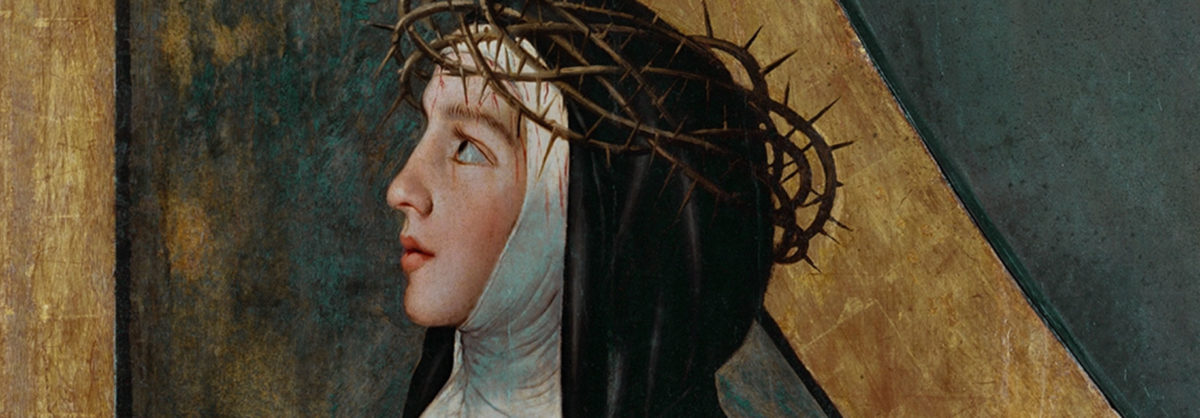

En cierto modo, es difícil imaginar dos almas femeninas más diferentes que las de Catalina de Siena y Elizabeth Ann Seton.
Virgen y Doctora de la Iglesia, Catalina vivió su vida entre visiones, éxtasis y milagros. Predicó públicamente a un grupo de discípulos ansiosos, escribió cartas apasionadas y suplicantes a papas y prelados, y realizó milagros de multiplicación de alimentos mientras ella misma ayunaba en extremo. Incluso estuvo casada místicamente con Cristo, que le dio un anillo de bodas invisible.
Elizabeth, on the other hand, was born in New York, in a time much closer to our own. She got married, had kids, and converted in a fairly normal manner. Even when she became a religious, she kept it real—with a staid, starched black bonnet and daily duties done with discretion. In her life there were no extreme miracles or metaphors, no weird circumstances for biographers to smooth over.
If Catherine was extreme, even fanatical—someone we might walk quickly away from if we saw her on the street—Elizabeth was a saint we can get close to, someone we could have over for dinner.
But, the truth must be told: Elizabeth was in her own way extreme—an oddity, an outlier—in exactamente de la misma manera que era Catherine.
En el corazón de las historias de ambos se encuentra la misma convicción que vemos en todos los santos, un apego casi absurdo que los diferencia de la mayor parte del resto de la humanidad. La religión, han descubierto los santos, no es ni sentimientos cálidos hacia Dios ni frases piadosas, ni una ética útil ni un impulso de buen corazón para alimentar a los hambrientos o educar a los pobres.
Para Isabel y Catalina, el centro del culto es un hombre, el hombre histórico real Jesús de Nazaret, que vivió, sufrió y murió y luego resucitó, y que hizo y sigue haciendo esta cosa tan increíble: darnos su cuerpo como alimento.
The saints totally buy this. They harbor an intense love for the Lord in the Eucharist—what looks to be bread and wine, but is realmente Su Cuerpo y Su Sangre.
Christ’s blood in particular was a big thing for Catherine, and it figures in her most intense visions. In one recurring vision, she feeds at Christ’s wounded side like a baby feeding at his mother’s breast. It was one of her main messages: this bread we are given to eat, this blood to drink, is the source, the center, the wellspring of our life, just as the mother’s milk is the only sustenance for her child.
Catalina dio testimonio de ello no sólo a través de sus visiones y escritos, sino en su propio body. Her biographer, Blessed Raymond of Capua, tells of how in the last ten years of her life she subsisted only on water and the Eucharist—a feat that has led many modern commentators to posit that at the heart of her vocation was nothing more than an eating disorder.
But if Catherine’s life looks pathological when viewed from our modern mentality, within the context of Christ’s own words, it makes total sense. Catherine is the living witness to what He says to us in the Gospel of John: “Os aseguro que si no coméis la carne del Hijo del hombre y bebéis su sangre, no tendréis vida en vosotros." (Juan 6:51).
Raymond tells us that there was a direct relationship in Catherine’s life between the Eucharist and her vital strength: “Her longing for more and more frequent communion was so intense that when she could not receive it her very body felt the deprivation, and her forces seemed to droop.” But, “whenever she received communion, a very torrent of graces and consolations flooded her soul.”
Isabel vivió este mismo tipo de dependencia de la Eucaristía. Incluso antes de hacerse católica, estaba hipnotizada por la idea de la Eucaristía, hambrienta de lo que no podía tener.
It is an interesting fact that when she was a child, the Episcopalian book of prayer stated that “the Body and Blood of Christ… son en verdad y de hecho tomadas and received by the faithful in the Lord’s Supper”—a recognition of Christ’s Real Presence in the sacrament. But in 1789, when Elizabeth was fifteen, the words “espiritualmente taken and received” were inserted, enshrining the idea that communion was a “reminder” of the Last Supper, not a memorial of it.
In front of this change, young and fervent Elizabeth found herself desperately hungering for a real connection with the Lord. The “symbolic” wine she received at the Episcopalian Sunday service could in no way slake the thirst she felt for Christ—as evidenced by her habit of going to the sexton after the liturgy to ask permission to drink what was left.
Elizabeth did not have a drinking problem any more than Catherine had an eating disorder; what she did have was an almost insatiable longing for the Eucharistic Lord, a desire that could not be satisfied by Episcopalian “communion.”
It was a wound in Elizabeth’s soul that opened her in unexpected ways to the Real Presence of Christ that she encountered in Italy after the death of her husband. The first thing that struck her was how Catholics acted around the Tabernacle.
When she first entered a Catholic church, she was fascinated by the “old men and women, young women and all sorts of people kneeling promiscuously about the altar.” And she tells of witnessing a priest unlocking a chapel door “with that composed and equal eye as if his soul had entered before him.” She confesses: “My soul would willingly have followed after.”
Before long, her fascination became focused on the Eucharistic host itself. When attending a Mass, she was the recipient of a loud, rude comment from a fellow Protestant visitor at the very moment of the consecration and found herself unexpectedly shaken by his irreverence. “My very heart trembled with shame and sorrow.”
Y luego está el impacto continuo y repetido de las procesiones eucarísticas que pasaban con frecuencia bajo la ventana de su habitación. Después de una de ellas, escribe en una carta a su amiga episcopaliana Rebecca,
"Qué felices seríamos si creyéramos lo que creen estas queridas almas: que poseer a Dios en el Sacramento. . . . Cuando llevan el Santísimo Sacramento bajo mi ventana . . . . No puedo contener las lágrimas al pensarlo. Dios mío qué feliz sería. . . si pudiera encontrarte en la iglesia como ellos".
This longing to believe what Catholics believe became for Elizabeth an unbearable pain. One day as the procession passed by she was so overcome that she threw herself down on the floor, and looking at a picture of Mary, begged for faith in the Eucharist. Elizabeth called this overwhelming desire for Christ in the Eucharist a “wildness” in her soul—and so it was. There she was, the sensible Episcopalian daughter reduced to jelly in front of a host carried in a monstrance out on the street. It was a Catherine of Siena moment.
I don’t need to tell you the rest of the story, how this fervor carried Elizabeth forward to the very day that she converted and then to the Eucharistic table where she was able to satisfy her hunger for the Lord at last. But I want to underline what both Catherine of Siena and Elizabeth Ann Seton are urging by the witness of their lives. Each, in their own vehement way, points us to Christ Himself, who wants to give Himself to us as food and drink. Through their lives, He repeats again that this is the very reason He has come: to unite himself with us bodily, to be with us in our cares and worries—not as a thought, an idea, but as a flesh-and-blood reality.
We ought to beg Catherine and Elizabeth to come to our aid here, to pray for us that we too should know this wild tearing at our hearts, that we should receive this incredible faith in our Lord’s Presence, a faith that is crazy—but true.
LISA LICKONA, STL, is Assistant Professor of Systematic Theology at Saint Bernard’s School of Theology and Ministry in Rochester, New York, and a nationally-known speaker and writer. She is the mother of eight children.
Imagen: Juan Bautista Mayno, Santa Catalina de Siena, Wikimedia Commons.
Esta reflexión se publicó anteriormente. Para ver todas nuestras reflexiones sobre Seton, haga clic en aquí.