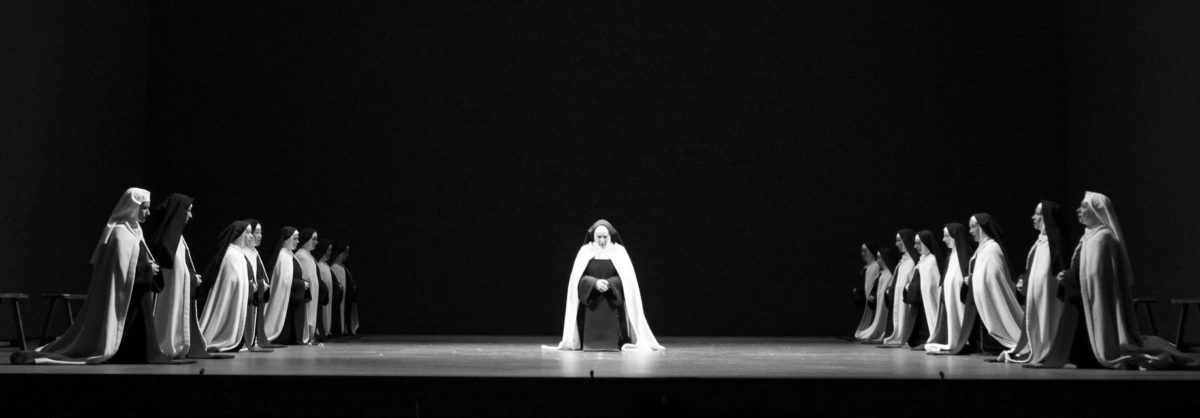

And there they are, invoking the Blessed Mother of Christ, as one by one they approach the scaffold and the guillotine which will end their mortal lives with a single swipe of the blade. “Salve Regina,” Hail Queen of Heaven,” they are singing now, all sixteen of them, members of the French Carmelite Order from Compiègne, forty miles north of Paris, forcibly transported to a Paris prison and condemned to death for treason by the so-called Committee of Public Safety of the National Convention of Revolutionary France.
Name them. Give these women their living names. Eleven Carmelites, three lay sisters, two tertiaries, all paraded in peasants’ clothes (their habits having been outlawed and confiscated), as they are trundled by cart through the streets of Paris for two hours this evening of July 17th, 1794.
A quick trial, with no legal defense allowed, the nuns singing hymns of praise the entire time to keep up their courage, including the Miserere, evening Vespers and Compline, Psalm 116—the “Laudate Dominum.” And, most touchingly, the Salve Regina.
They range in age from the mid-twenties to nearly eighty years old. There’s the prioress, Mother Teresa, age forty-two, highly educated, her convent dowry once paid for by none other than Marie Antoinette herself. Then there’s the sub-prioress, Mother St. Louis, also forty-two. Then Mother Henriette of Jesus, ex-prioress for two terms, and now novice mistress, age forty-nine. Then Sisters Mary of Jesus Crucified and Charlotte of the Resurrection, both seventy-nine. Then—look—there’s Sister Euphrasia of the Immaculate Conception, fifty-eight, Sister Teresa of the Sacred Heart of Mary, fifty-two, Sister Julie Louise of Jesus, fifty-three, and Sister Teresa of St. Ignatius, fifty-one. Then Sister Mary-Henrietta, thirty-four, and Sister Constance of St. Denis, a twenty-eight-year-old novice and the youngest, who—barred from making her final vows by the anti-clerical laws of the French Republic, professes her vows now to Mother Teresa, even as she is led to the guillotine.
Add to these three lay sisters: Sister St. Martha and Sister Mary of the Holy Spirit, both fifty-one, and Sister St. Francis Xavier, who is thirty. Then, finally, two tertiaries, Catherine Soiron, fifty-two, and Thérèse Soiron, forty-six, both of whom have served the community for the past two decades.
Uno a uno caminan, con valentía o tropezando, con la cabeza alta, buscando el consuelo que puedan encontrar en los ojos de los demás mientras invocan a la Virgen. Viajes que conducen al no o al sí final, viajes que cada uno de nosotros debe hacer.
And here’s the thing: nothing captures that scene like Francois Poulenc’s opera, Diálogos de los Carmelitas, especialmente en esa escena final, cuando uno a uno van saliendo del escenario en penumbra, invocando a María, esa dulce Madre, con los versos suavizados por el tiempo del Salve Regina.
Regina, mater misericordiae:
Vita, dulcedo, et spes nostra, salve.
Ad te clamamus, exsules, filii Hevae….
Dios te salve, Santa Reina, Madre de Misericordia,
¡nuestra vida, nuestra dulzura y nuestra esperanza!
A ti clamamos, pobres hijos desterrados de Eva.
A ti elevamos nuestros suspiros, lamentos y llantos
¡en este valle de lágrimas!
Vuélvete, pues, oh clementísimo Abogado,
tus ojos de misericordia hacia nosotros,
y después de esto, nuestro exilio, muéstranos
el fruto bendito de tu vientre, Jesús.
Oh clemente, oh amorosa, oh dulce Virgen María.
Georges Bernanos, ese extraordinario novelista católico, escribió el libreto original de la ópera, modificado posteriormente por Poulenc. El sitio Diálogos se estrenó en La Scala en versión italiana a finales de enero de 1957, aunque posteriormente se ha traducido y representado ante un público agradecido en francés, alemán, español e inglés en París, San Francisco, Nueva York, Madrid y Sydney (Australia).
After this, our exile…. As powerful as the opera (and the film adapted from the opera) and the novel are, it’s that final scene which stays with you, as one by one by one the nuns walk offstage (guarded by two soldiers) to meet the guillotine and we are jarred again and again by the swish of the guillotine’s blade dropping, momentarily disrupting the orchestra and the singing of the nuns, their voices diminishing one by one. And then we are left only with the silence, as one by one the soldiers too depart…for the next round of executions. And then it’s the crowd—those stunned witnesses—leaving the stage, leaving behind two intersecting streets that form a glowing cross.
Earlier, in Act 1 of the opera, we witness the former Mother Superior suffer an agonizing death, believing that—despite her having given her life to what she believed, she has been abandoned in the end by God.
A young aristocratic woman named Blanche, who has recently joined the Order out of fear and to avoid the anti-aristocratic sentiments and the anti-clericalism of the mob, is told that that is not how the Order works, but rather by freely giving oneself to God. Later, those same Carmelites take a unanimous vote to suffer martyrdom, if necessary, rather than abandon their vows. Blanche, it turns out, leaves the convent and returns home, following the death of her father, who has been guillotined. But now, as the nuns process toward their deaths, Blanche—despite those very human fears we can all understand—voluntarily joins them, singing the final stanza of the Veni Creator Spiritus—Come Holy Spirit—as she too offers her life to God.
And here’s the thing. Anyone watching this final scene unfold, no matter how that scene is performed, would have to ask where we would stand given those same circumstances. Would we have the courage to stick by our deepest convictions? Or would we turn away, recant, and say the whole thing was a delirium, a fiction really, and go on living for however long or short our lives turned out to be?
¿O nos entregamos como testigos de Cristo y de su Madre?
And isn’t that what that other Mother, Elizabeth Ann Seton, did with her own witness? An Episcopalian from a well-to-do family in New York City, who would step by step follow the path she felt called to, converting to the Catholic faith in spite of the fractures it caused in her own family and among many of her friends?
She was twenty-years old when the Carmelites of Compiègne were martyred. As it turned out, Robespierre himself—that mastermind of the Terror—would himself be guillotined just ten days later, and there were many at the time who believed that the sacrifice of those sixteen nuns was a major force in finally quelling the insanity of the Terror.
Veinte. Y casada sólo seis meses antes con William Magee Seton. Pero vivía en una sociedad que al menos permitía la tolerancia religiosa y el pluralismo tras la Revolución Americana, aunque el catolicismo seguía siendo sospechoso entre muchos ciudadanos de la República Americana de la época.En otra media docena de años, Elizabeth perdería a su marido a causa de la tuberculosis en Italia, y se quedaría a cargo de la crianza de sus cinco hijos.
Con el tiempo se convertiría, perdiendo muchas de sus conexiones más ricas, y encontrándose luchando para llegar a fin de mes enseñando a los pobres y abandonados en Nueva York, antes de trasladarse a Baltimore, y luego a Emmitsburg, Maryland, donde fundaría una nueva orden, las Hermanas de la Caridad de San José, y establecería la primera escuela católica gratuita para niñas dirigida por religiosas en la nueva nación.
Despite illness and fatigue, Elizabeth continued to care for the sick and the destitute, writing eloquent letters of encouragement to so many. In time she even came to work with several French priests who had witnessed the Reign of Terror themselves. In time too she would lose two of her beloved daughters to early deaths and lose her own life to illness at forty-six. And in time—150 years on—she would become the first American born here to be declared a saint by the Catholic Church.
Escuchad. Hasta el día de hoy se oyen esos cantos en las guardias de las horas de los Carmelitas, así como de las Hermanas e Hijas de la Caridad, mientras llevan a cabo su trabajo. Incluso se oyen ecos de la Salve Regina, voces clamando a esa dulce mujer, nuestra Reina del Cielo, para que también a nosotros se nos muestre después de este nuestro destierro, el fruto bendito de tu vientre, Jesús.
PAUL MARIANI es Catedrático emérito de Inglés en el Boston College. Es autor de diecinueve libros, entre ellos biografías de William Carlos Williams, Gerard Manley Hopkins y Wallace Stevens. Sus anteriores volúmenes de poesía incluyen Epitafios para el viaje, La gran rueda y Operaciones de salvamento. También es autor de Treinta días: On Retreat with the Exercises of St. Ignatius y The Mystery of It All: The Vocation of Poetry in the Twilight of Modernity.
Imagen: La ópera "Dialogues des Carmelites" de Francis Poulenc en el Theater an der Wien de Viena, 13 de abril de 2011 / REUTERS / Alamy Stock Photo
Para leer más ensayos sobre Seton y la cultura, haga clic en aquí.