
The first women who came to Emmitsburg seeking admittance to Elizabeth Ann Seton’s new community of sisters were for the most part serious, devout, and ready to sacrifice themselves for God. As their spiritual mother, Elizabeth’s job was to determine how much self-denial they could safely handle, so she turned to the writings of three saints with extensive experience as leaders of religious communities: Vincent de Paul, Teresa of Avila, and the Cistercian known as Bernard of Clairvaux.
Perhaps to her surprise, the famously austere Bernard counseled moderation. Given the severe ascetical practices of the early Cistercians, Elizabeth thought his definition of “moderation” was almost funny: as she put it, “[i]t is well known that this consisted of. . . badly prepared vegetables” to supplement the “wild fruit and leaves as were to be found in the deserts they inhabited.” But in time she came to understand his point: it was not extreme acts but daily regulation of the will that led to genuine transformation.
Though Elizabeth and Bernard no doubt shared similar leadership experiences, their preparation for these roles could not have been more different. Bernard was born in the late eleventh century, when young children were still being given to monasteries as so-called “irrevocable oblates” to be educated and religiously formed for lives as monks and nuns. But people were starting to question whether this practice truly produced the best monastics and—even more importantly—whether it violated the right of a growing child to choose his own path. Perhaps this is why, when Bernard turned nine, his aristocratic parents sent him instead to a school run by secular canons, or priests.
During this era of monastic reform, medieval Christians caught up in the spirit of change were also rediscovering the contemplative spirituality of the Desert Fathers. Grown men and women were giving away their possessions, setting aside their marriage vows, and flocking to monasteries or even heading into the wilderness to become hermits.
One such experiment in desert spirituality was launched by Robert of Molesme in the forests of France eight years after Bernard was born. Known as Cîteaux Abbey, it became the first foundation of the new Cistercian order, which was organized around a literal interpretation of the sixth-century Rule of St. Benedict. Intent on adopting a far more physically and psychologically demanding life than practiced by other monasteries of the day, the Cistercians were one of the first orders to reject irrevocable oblature for children.
Though young Bernard thought seriously about ordination from the time he was young, the decisive moment came in his late teens when his beloved mother died. He was deeply shaken by her death, crediting the loss with setting him on “a long path to complete conversion” through a life of solitude and prayer. In 1113, he and thirty other young noblemen of Burgundy, including several of his soldier brothers and a knightly uncle, set off for Cîteaux Abbey to become monks.
Two years later, Bernard was charged with founding a daughter house seventy-five miles away in the isolated Vallée d’Absinthe, a land so harsh it was nicknamed the “Valley of Bitterness.” With twelve other monks, this newly appointed young abbot began clearing the thick forest, building crude cells, and figuring out how to grow enough food to sustain the community. Their first years were marked by severe poverty, gnawing hunger, and physical exhaustion. But somehow, they survived, and as word of this remarkable spiritual community and its charismatic leader began to spread, more hopeful novices arrived. At its peak, Clairvaux, which means “Valley of Light,” supported a population of seven hundred monks. By the time Bernard died, the Cistercians had founded a total of 345 monasteries throughout Europe, with nearly half belonging to Clairvaux’s monastic lineage.
Meanwhile, Bernard had more work to do. In 1129, he assisted at the Council of Troyes, a convocation of bishops intended to settle certain disputes within the Church in France. He played an influential role in the council’s work on a rule for a special military order formed after the First Crusade to protect pilgrims on their arduous journeys to the Holy Land.
Bernard championed the Knights Templar as soldier monks who lived under strict vows of poverty, chastity, and obedience and who fought to protect Christian pilgrims and defend the Holy Land. The Rule itself contrasted the Templars with secular knights whom it accused of plundering, despoiling, and killing rather than defending the poor, widows, orphans, and churches. Bernard’s vision contributed to the broader medieval Christian ideal of chivalry, which sought to place moral and religious restraints on knightly violence.
Though divided by centuries, stations in life, and geographic locations, Bernard and Elizabeth shared a rare gift; they were both highly effective evangelists who not only helped trigger individual conversions to the Catholic faith but influenced many more to enter religious life. According to the scholar Adriaan Bredero,
The frequently quoted remark of William of Saint-Thierry that mothers kept their sons, wives their husbands, and men their friends, hidden from Bernard in order to save them for this world, may well be primarily applicable to the period prior to his entry in Citeaux; but the accompanying characterization of Bernard as a “fisherman in God’s service,” remained valid his whole life.
Elizabeth was equally persistent in her efforts to convert those around her. One of the first was Cecilia, her sister-in-law, who became fascinated by Elizabeth’s Catholicism despite her family’s stern disapproval. Elizabeth believed that the fourteen-year-old girl, whose life would clearly be cut short by consumption, deserved honest answers. She formed a secret prayer circle that included Cecilia, her older sister Harriet, and their cousin Eliza, and eventually Cecilia formally entered the Church. Later, at Emmitsburg, many other young women, including the by-now-engaged Harriet, made the decision to convert and join the newly formed community. By the time Elizabeth died, eighty-six women had become Sisters of Charity of St. Joseph.
What accounts for the charismatic effect St. Bernard of Clairvaux and St. Elizabeth Ann Seton had on those seeking a deeper spiritual life?
First, their unshakeable commitment to faith was visible in everything they did, and others clung to their rocklike strength of mind and purpose. Second, they could both draw on a vast store of knowledge about the life of the spirit. Bernard was immersed from childhood in a Christian curriculum, and Elizabeth studied the Christian classics under the tutelage of the erudite French priest Simon Bruté, a professor of literature and theology at Mount St. Mary’s who became her close friend and spiritual director. Third, they were both fearless. Elizabeth steadfastly resisted all efforts of her Protestant family and social circle to dictate her relationships with those who sought her counsel.
Bernard showed the same fearlessness, dealing deftly with people at the very pinnacle of ecclesiastical authority, even when they had the power to do him harm.
Perhaps most importantly, however, both believed in free will and in everyone’s God-given ability to make the right choice if only they are listened to and encouraged. As Bernard put it,
We have seen how every soul—even if burdened with sin, enmeshed in vice, ensnared by the allurements of pleasure, a captive in exile, imprisoned in the body, caught in the mud, fixed in mire, bound to its members, a slave to care, distracted by business, afflicted with sorrow, wandering and straying, filled with anxious foreboding and uneasy suspicions, a stranger in a hostile land, and according to the prophet, sharing the defilement of the dead and counted with those who go down to hell—every soul, I say, standing thus under condemnation and without hope, has the power to turn.
Elizabeth’s list of the impediments to conversion, though less dramatic than Bernard’s, gives potential converts just as much reason to hope:
If till now you have heard the word of God with dissipation and without any recollection, with indifference and insensibility, with a mind employed about a thousand trifles and useless thoughts, acknowledge humbly your fault. Ask pardon from your God. Entreat his goodness most earnestly to stop your volatile mind, to mollify your heart so unfaithful to his grace, to disengage it from vain things which engage all your attention. . . make it like good soil which may preserve the good seed, foster it, and bring forth its fruits a hundred-fold.
Sources for Quotes
Paul Diemer, Love Without Measure: Extracts from the Writings of St. Bernard of Clairvaux (Kalamazoo: Cistercian Publications, 1990).
Adriaan Bredero, Bernard of Clairvaux: Between Cult and History (Grand Rapids: Eerdmans, 1996).
Classics of Western Spirituality, Bernard of Clairvaux: Selected Works (New York: Paulist Press, 1987).
Catherine O’Donnell, Elizabeth Seton: Santa estadounidense (Ithaca: Cornell University Press, 2018).
Betty Ann McNeil, D.C., 15 Days of Prayer with Saint Elizabeth Ann Seton (Hyde Park: New City Press, 2002).
PAULA HUSTON es becaria del Fondo Nacional de las Artes y autora de dos novelas y ocho libros de no ficción espiritual. Sus ensayos y relatos han aparecido en Best American Short Stories y en la antología anual Best Spiritual Writing. Al igual que la Madre Seton, Huston es una conversa al catolicismo. En 1999, se hizo oblata benedictina camaldulense y es miembro laico de la comunidad de monjes de New Camaldoli Hermitage en Big Sur, California. También es ex presidenta de la Sociedad CrisóstomoOrganización nacional de escritores cristianos literarios.
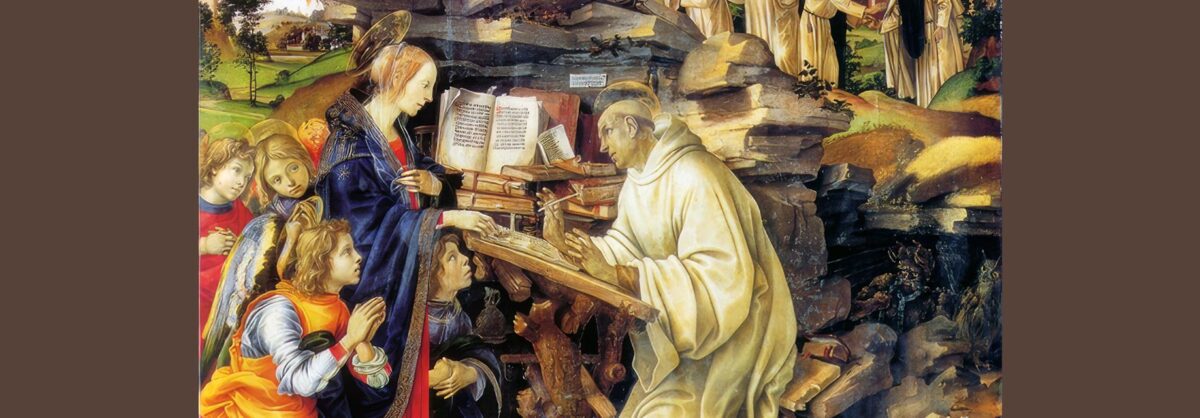
Image: Detail of Apparition of the Virgin to Saint Bernard, Filippino Lippi, 1485–1487.