Most of us think of psychology as a uniquely modern invention, introduced by a pipe-smoking German psychoanalyst named Sigmund Freud. Today’s most popular form of psychological counseling—Cognitive Behavioral Therapy, or CBT—owes much to Freud’s discoveries.
Utilizada para tratar adicciones, ira incontrolable, ansiedad, depresión, trastornos alimentarios y otros problemas de salud mental intratables, la TCC se centra en descubrir los patrones de pensamiento automáticos que causan trastornos emocionales y sustituirlos por otros más útiles.
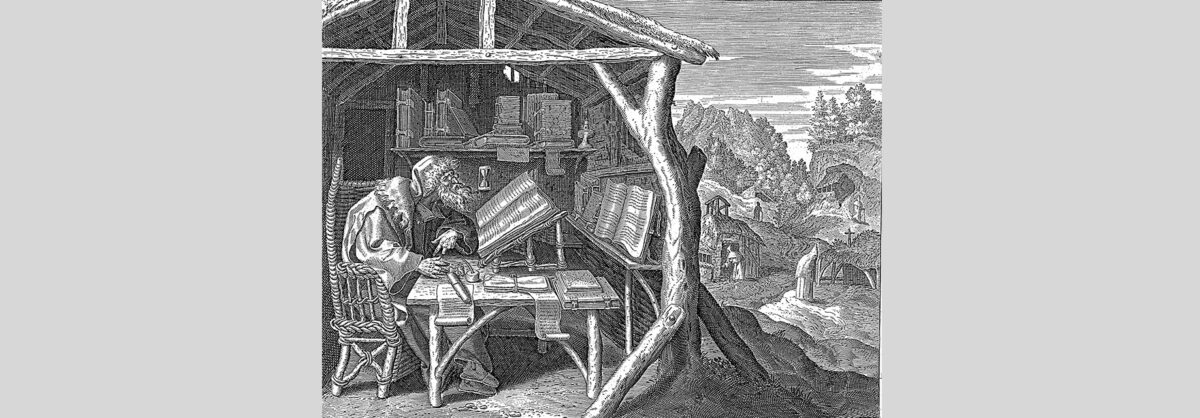
Pero Freud y la TCC no surgieron de la nada. Hace mil setecientos años, un padre del desierto llamado Evagrio de Ponto enseñó a unos jóvenes monjes una versión del mismo enfoque.
Born in Ibora, Pontus, in 345, Evagrius grew up near the family estate of St. Basil, one of Christianity’s great theologians. Early on, Basil took notice of the brilliant young Evagrius, ordaining him a lector and inviting him into his inner circle. One of Basil’s primary interests was monasticism, and he strongly encouraged his followers, including Evagrius, to become monks.
Though he gave Basil’s suggestion serious consideration, Evagrius was more drawn to the intellectual dynamism of Constantinople, where he had already achieved some status. City life proved too seductive, however. He became “careless, worldly, and delicate,” spending hours on his physical appearance and being pampered by slaves. Whatever religious discipline he’d developed under the tutelage of Basil soon faded, even as he continued to preach and teach the Gospel.
Then the bottom dropped out. He fell in love with a married woman. His struggle to contain this secret passion felt doomed, and he nearly caved into despair. But a powerful, numinous dream, during which he vowed to leave Constantinople to “watch after his soul,” sent him fleeing to Jerusalem. There, he found lodging on the Mount of Olives in a hospice for pilgrims established by a wealthy Roman widow called Melania.
Melania había visitado a los ermitaños y monjes del desierto egipcio e incluso había vivido allí durante seis meses con la colonia de Nitria. Era apreciada y respetada por muchos de los ancianos, que la consideraban una maestra espiritual dotada por derecho propio.
When Evagrius fell gravely ill and was sick for months, it was Melania who discovered the underlying cause. When he was drifting back to his big city ways and feeling guilty about once again failing to “watch after his soul,” it was Monica who urged him to finally become a monk.
Evagrio fue primero a Nitria, donde se convirtió en discípulo de varios de los ancianos más santos, y luego se trasladó a las Células, una comunidad aún más austera de ermitaños del desierto, donde permaneció durante los siguientes catorce años.
To curb his passionate nature, Evagrius adopted severe ascetical practices, living on a little bread and oil, sleeping only a few hours a night, standing outside in the winter cold, and reciting a hundred prayers each day. The strict regimen calmed him, and as he became humbler and more loving his reputation for wisdom and holiness grew. According to the many who flocked to him for spiritual direction, Evagrius was able to “discern the spirits.”
Palladius, historian of the Desert Father era, writes, “The brothers would gather around him on Saturday and Sunday, discussing their thoughts with him throughout the night, listening to his words of encouragement until sunrise. And thus they would leave rejoicing and glorifying God, for Evagrius’ teaching was very sweet.”
But if he sensed a monk needed individual counseling, Evagrius would say, “My brothers, if one of you has either a profound or a troubled thought, let him be silent until the brothers depart and let him reflect on it alone with me. Let us not make him speak in front of the brothers lest a little one perish on account of his thoughts and grief swallow him at a gulp.”
Evagrius’ gift of discernment was rooted in his view of the soul as “tri-partite” (having three distinct faculties). This was Plato’s theory, but Evagrius thoroughly Christianized what Plato first proposed.
Evagrius believed our souls have a calm reasoning part, a desiring or longing part, and an indignant or angrily reactive part, and we must learn to control these passions so that they don’t control us. Our goal is to achieve apatheia, o un estado de profunda paz interior, de modo que no nos veamos constantemente sorprendidos por nuestros dramas emocionales.
Though modern psychologists since the time of Freud have warned against the dangers of repressing our emotions, Evagrius’ apatheia no es una negación fría y robótica de nuestros sentimientos, sino una calma constante que nos libera para contemplar el mundo con una forma pura de amor que él llamó ágape.
When we are “beside ourselves” with anger or “swept away” by desire, then apatheia se interrumpe y ágape no puede funcionar. Son dos caras de la misma moneda.
But what triggers these angry or desiring passions in us? Evagrius’ great realization was that emotions are preceded by thoughts. What if he could categorize the most disruptive of these thoughts and devise antidotes for them?
Al comienzo de su famoso tratado conocido como el Praktikos, Evagius says, “There are eight general and basic categories of thoughts. . .. First is that of gluttony, then impurity [lust], avarice [greed], sadness [self-pity], anger, acedia [the sense that nothing means anything, and all action is futile], vainglory [addiction to public acclaim], and last of all, pride. It is not in our power to determine whether we are disturbed by these thoughts, but it is up to us to decide if they are to linger within us or not and whether or not they are to stir up our passions.”
The best way to disarm these thoughts is first to reveal them to a wise elder and then to counter them with an opposing thought or action. For example, “when the soul desires to seek after a variety of foods then it is time to afflict it with bread and water that it may learn to be grateful for a mere morsel of bread.” Or, “anger is calmed by the singing of Psalms, by patience and almsgiving.” Or, if acedia is the problem, “the monk should. . . live as if he were to die on the morrow but at the same time he should treat his body as if he were to live on with it for many years to come.”
Evagrio aprendió por las malas lo dolorosa y destructiva que puede ser una pasión desenfrenada. Elizabeth Seton aprendió la misma lección de niña, mientras lloraba la pérdida de su madre, añoraba a su padre ausente e intentaba navegar por la vida con una madrastra inestable y poco cariñosa.
Later, while in Italy as a new widow still in mourning, Elizabeth struggled with a powerful emotional fixation on the married Antonio Filicchi. Her way of coping with these overwhelming feelings was to invent her own form of stoicism. She simply wouldn’t allow herself to care so deeply.
Evagrius’ quest for apatheia can sound somewhat like Elizabeth’s quest to drift calmly above life with all its trials. But the difference lies in the motivating impulse.
En sus primeros años, Isabel buscaba desesperadamente un poco de paz, aunque eso significara ignorar, reprimir o negar sus sentimientos más profundos. Evagrio adoptó el enfoque opuesto: las emociones poderosas y los pensamientos que las precipitan deben ser examinados y tratados a fondo, preferiblemente con la ayuda de un anciano sabio, para liberar el alma para el amor genuino. Apatheia was another name for the simplicity of spirit Jesus was referring to in Matthew 5: “Blessed are the pure in heart for they shall see God.”
Though Elizabeth was not formed in Evagrius’ desert tradition, she gravitated naturally to the great truths found there. But first she had to give up her self-protective stoicism and begin identifying the thoughts that triggered emotional turmoil.
One thing she noticed was her habit of passing harsh judgments on others. As the disillusioning difficulties of starting her new community of Sisters in the remote countryside of Maryland began to mount, she realized her judgmental thoughts were rooted in pride. She saw herself as wiser, more virtuous, and more spiritually adept than most, yet the fact was she was “more willful than she’d believed, less able to ‘look up’ than she’d imagined, and more often deprived of a sense of God’s presence than she’d hoped.”
How to counter such judgmentalism? “No more would she allow herself to close the door against those she found uncongenial.” In the process of opening her heart to people who irritated her, she became more sympathetic and affectionate. As she wrote, “I am not enabled as Jesus Christ to do miracles for others, but I may constantly find occasions of rendering them good offices and exercising kindness and good will toward them.” Like Evagrius, she came to believe that “constant attentiveness to God and others would remake a person from the inside out.”
The Evagrian scholar Richard Bamberger says, “The method of observation employed by Evagrius is as close to a scientific psychology as clinicians are now able to establish.” But unlike contemporary Cognitive Behavioral Therapy, which strives to help its clients function better and feel happier about themselves, “for Evagrius such observation was a form of searching for God.”
Como seguramente lo fue también para Isabel.
PAULA HUSTONis a National Endowment of the Arts Fellow and the author of two novels and eight books of spiritual nonfiction. Her short stories have honored by Best American Short Stories and her essays have appeared in the annual Best Spiritual Writing anthology. Like Elizabeth Ann Seton, Huston is a convert to Catholicism. In 1999, she became a Camaldolese Benedictine Oblate and is a lay member of New Camaldoli Hermitage’s community of monks in Big Sur, Calif. She’s also a former president of the Sociedad CrisóstomoOrganización nacional de escritores cristianos literarios.
Haga clic en aquí para leer todos los ensayos de Seton & Culture.
Imagen: Shutterstock