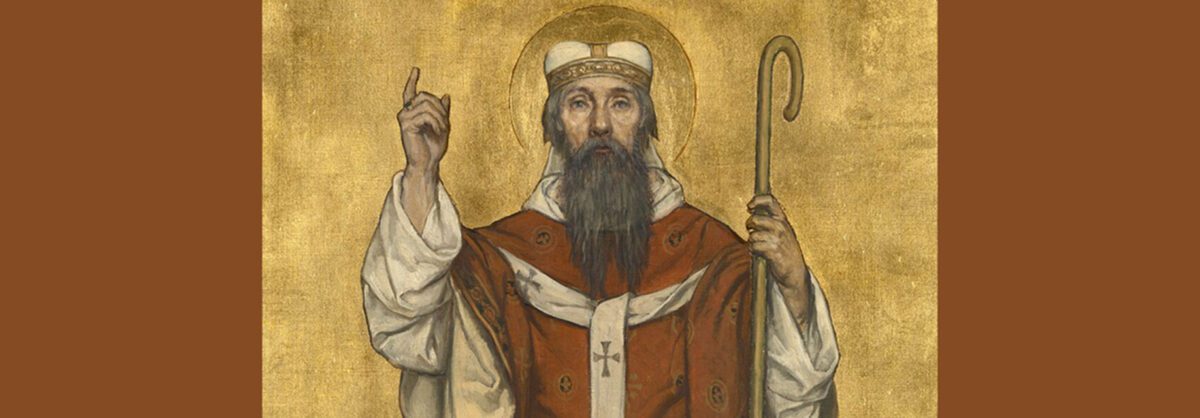

St. Boniface was a “true son of St. Benedict,” Pope Benedict XVI wrote. He said Boniface’s physical and scholarly toil exemplified an expanded version of the Benedictine motto, not just ora et labora, but “prayer and labour (manual and intellectual), pen and plough.”
St. Elizabeth Ann Seton was also a practitioner of “elbow grease and ink” — a true daughter of the Vincentian spirituality that formed her own congregation of religious sisters, a fidelity that, Pope Leo XIV says, “opened doors for girls, migrants and the marginalized.”
Boniface was the son of island tribes who got his decisive direction from Rome.
Around 675 AD. Boniface, who was baptized Winfrid, was born to an Anglo-Saxon family in what would become England’s southern section, Wessex.
At that time, the island was a land of Germanic tribes who had been evangelized less than a century earlier by the Benedictines at the command of Pope Gregory the Great. Winfrid got to know the Benedictines well, and entered the order. Their mission of education suited his scholarly intellect.
At his ordination, in 705 at age 30, Boniface said: “I profess integrally the purity of the holy Catholic faith and with the help of God I desire to remain in the unity of this faith, in which there is no doubt that the salvation of Christians lies.”
He embarked on an unsuccessful missionary trip to what is now northern Germany and the Netherlands, and then returned home. When he was finally able to rejoin the missions, he met with the pope at the time, Gregory II, who was so impressed with the monk that he renamed him bona facere (to do good), or Boniface.
In 722, Gregory consecrated him as a missionary bishop — Rome’s front-line commander in places as wide-ranging as Bavaria, Thuringia, and Hesse and as far-flung as Frisia.
He lived in a time when the culture of Europe on the continent had collapsed, however. The Western Roman empire fell in 476, and large swaths of the empire had relapsed into paganism. In the Catholic places there was little uniformity of worship or communication with Rome.
The times demanded that Boniface do mighty works with his pen. So he did.
Boniface embraced Rome’s primacy and helped re-establish inroads between Rome and the tribal lands that had slipped from communion. That meant, for one thing, teaching Latin. Boniface taught Latin grammar and would write Latin prose works of scholarship as well as poetry. His work Ars grammatica spread the Latin language to connect the churches to the Church and his Ars metrica taught Latin poetry. He shared his own Latin poems and sermons.
But Boniface evangelized directly through letters. For example, in 723 he shared with another bishop his method of evangelizing pagans. Questions “should be put to them, not in an offensive and irritating way, but calmly, with great moderation,” he said. For example:
“Once they admit their gods have a beginning, you should ask them whether the universe had a beginning … For before there was a universe, there was no place for the gods to live,” he wrote. “But if they answer that the universe has no beginning … simply ask them Who ruled the universe, then? How did the gods come to rule the universe, if it existed before them? Where did the first gods and goddesses come from?”
His Socratic approach went on to establish Christian truths.
But the plough — and the axe — marked his work too.
Boniface knew how to discuss the faith with pagans, because he wasn’t an ivory tower academic — he was a tireless builder, creating new male and female monasteries that became educational centers important to the future of the faith in Europe.
And the two iconic events of his life were also acts of brawn, not brains: the death of an ancient tree and his own martyrdom.
Boniface’s most famous act was to fell a huge oak associated with the god Thor in Geismar in central Germany. Such trees were places of sacrifice, and it was said that infants were killed there to keep Thor happy. Boniface announced his intention to fell the tree with his axe, and then did so in front of watching, frightened pagans, who expected him to be struck dead by lightning at any moment.
The people were astonished when the tree fell apart in four pieces, and Boniface himself was unharmed by Thor. A later tradition links this story to the Christmas tree — a tree that symbolizes God’s pleasure in the birth of an infant, not the death of infants to please a god.
The axe is part of Boniface’s iconography — but so is a Gospel book pierced by a sword, representing his martyrdom. He was martyred after returning, when he was almost 80, to northern Germany, the first place he tried, and failed, to win for Christ as a young man.
While he was beginning Mass on June 5, 754, he was assaulted by a band of pagans. An account of his martyrdom says that his Gospel book was pierced by a sword and his last words were recorded as: “Here is the long awaited day, the time of our end has now come; courage in the Lord!”
Our own recent German Pope, Benedict XVI, said he was personally grateful for what St. Boniface did for his native land:
“His ardent zeal for the Gospel never fails to impress me. At the age of 41 he left a beautiful and fruitful monastic life, the life of a monk and teacher, in order to proclaim the Gospel to the simple, to barbarians. … He was so passionate about the word of God that he felt the urgent need and duty to communicate it to others, even at his own personal risk.”
Of course, another child of England who found her vocation in Italy prayed and worked to spread the Gospel.
What Boniface did in Germany, spreading institutions rooted in Christ and connected to Rome, educational pioneers did in America. Pope Benedict also said that “Towering figures, like Saint Elizabeth Ann Seton and other founders and foundresses, with great tenacity and foresight, laid the foundations of what is today a remarkable network of parochial schools contributing to the spiritual well-being of the Church and the nation.”
Mother Seton and St. Boniface both had the same Catholic impulse — to create order where there is disorder and clear confusion where there is confusion, and to connect their beloved people directly to Jesus Christ.
TOM HOOPES, autor más reciente de El Rosario de San Juan Pablo II, es escritor residente en el Benedictine College de Kansas, donde imparte clases. Es anfitrión de La extraordinaria Story podcast sobre la vida de Cristo. Su libro Lo que dijo realmente el Papa Francisco ya está disponible en Audible. Antiguo reportero en la zona de Washington, D.C., fue secretario de prensa del Presidente del Comité de Medios y Arbitrios de la Cámara de Representantes de los Estados Unidos y pasó 10 años como editor del periódico National Catholic Register y de la revista Faith & Family. Su trabajo aparece con frecuencia en el Register, Aleteia y Catholic Digest. Vive en Atchison, Kansas, con su esposa, April, y tiene nueve hijos.
Image: Wikicommons
To view all of our Seton Reflections, click aquí.