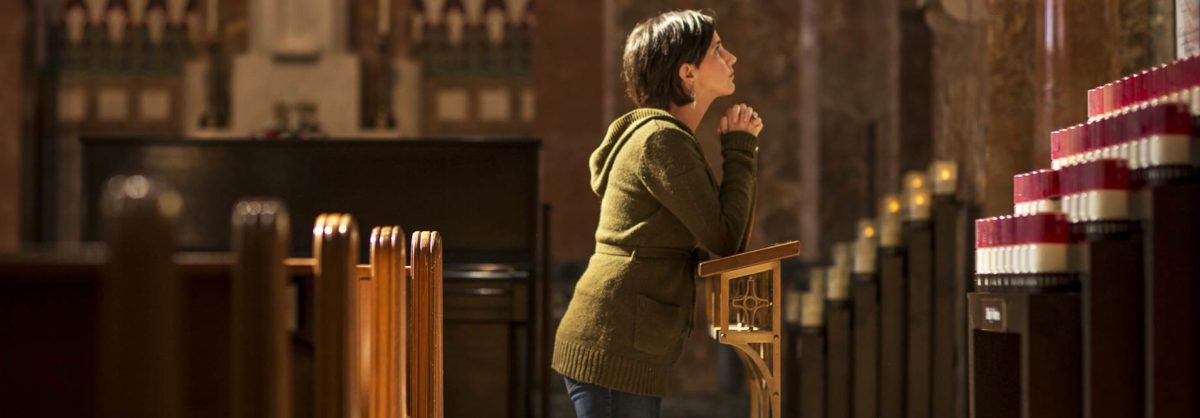

“These are hard words to pray,” said the woman in my parish prayer group as we all prayed the Stations of the Cross together recently. We were using a small booklet of prayers written by St. Ignatius.
“I love you more than I love myself,” the text read, and “Take me as your own, Lord, and do with me what you will.”
Others in our group felt the same as the first woman. “I can say those kinds of words in prayer,” they said, “but it’s hard to actually mean them.”
I agree. I will never forget the time that a close friend’s baby was very sick and she asked me to pray for his recovery. When the baby’s fever spiked and he was admitted to the hospital, doctors scrambled to figure out what was wrong, and everyone feared the worst. I sat in a church pew that day and attempted to pray an Our Father, but I choked on the words.
“Thy kingdom come, thy will be done … ”
I stopped short. I couldn’t bring myself to pray for God’s will to be done because I didn’t know what God’s will was. What if God’s will didn’t match my own?
My hesitation forced me to face an uncomfortable fact. In the past, when I had blithely prayed those pretty words and felt so smug about my own submission and piety, what I had really been praying was “Thy will be done, as long as it matches my own will.” Or perhaps “Thy will be done, as long as it doesn’t include any of these unpleasant things over here.”
No tu voluntad. Mi voluntad.
Aunque es posible que en sus primeros años luchara con una inquietud similar, Santa Isabel Ana Seton acabó encontrando una notable sensación de paz en esas mismas palabras que a mí a veces todavía me cuesta rezar.
“’Thy will be done’ – What a comfort and support those four little words are to my soul,” escribió una vez. “I have repeated them until they are softened to the sweetest harmony.”
I find hope for myself in how she described repeating the words until they are softened and sweetened. I can say the words; I’m just not always sure that I mean them.
In the end, my misgivings are always a failure of trust. A failure of trust that’s at the root of every sin I might ever be tempted to commit. Like Eve in the garden, I am not so much tempted by sumptuous fruits as I am tempted to doubt. That’s where it starts. When we let doubt creep in.
“But the serpent said to the woman, ‘You will not die. For God knows that when you eat of it your eyes will be opened, and you will be like God, knowing good and evil.’” – Genesis 3:4-5
Like Eve, I sometimes listen to lies and entertain them. I doubt God’s goodness. I doubt God’s love. I listen to a slithering serpent in my mind who suggests that God might not want good things for me. He might be keeping them for himself. If I want good things, this voice suggests, I will need to take them for myself.
Tal vez, como Santa Elizabeth Ann Seton, necesito repetir palabras de confianza y fe hasta que se suavicen y endulcen para mí. Hasta que pueda sentirlas.
A principios de año, consciente de la debilidad de mi fe, me comprometí a rezar el Letanía de la confianza cada día. Esperaba que esta oración diaria me ayudara a ver dónde me llama Dios a crecer en confianza este año. Después de empezar esta práctica, rápidamente me di cuenta de que si quería crecer en confianza, también tendría que crecer en humildad. Las dos cosas están entrelazadas.
All the ways I am tempted not to trust God are caught up in my sinful pride. I can’t abandon my own will and pray for God’s will to be done because I know what’s best. Necesito estar al mando. Necesito llevar la voz cantante.
Y así añadí el Letanía de la humildad to my daily practice. I especially like the repetition of these litany prayers. Day after day, as I repeat words of trust and humility, I place in God’s hands my longing to mean them.
Líbrame, Jesús.
Confío en ti.
Concédeme la gracia de desearlo.
I am grateful for the reminder that it takes grace to desire these things. To let go. To lean in. To trust in a God who loves us and wants every good thing for us. We don’t do these things alone.
In my prayer group the other night, I shared a thought with the other women. When I was young, one of the ways my parents taught me my Catholic faith was by having me memorize parts of the Catechism. I committed to memory many passages that contained large words that I didn’t yet fully understand. As I grew older, though, I grew in my understanding of many of these passages. I grew into these words of truth I had memorized when I was a child. I said the words until I could begin to understand them.
Creo que podemos crecer en nuestras oraciones de una manera similar. Podemos decir las frases más duras, aunque recemos para que tengan sentido. Podemos seguir rezando y pronunciando las palabras, aunque le pidamos a Dios que ablande nuestros corazones para que entiendan su significado.
Ayúdame a confiar. Hazme humilde. Hágase tu voluntad.
Like St. Elizabeth Ann, we can repeat our prayers – even the tough ones – until the words are “softened to the sweetest harmony.” Until we grow into them. Until we love God and trust Him with perfection.
DANIELLE BEAN es escritora y popular conferenciante sobre la vida familiar católica, la paternidad, el matrimonio y la espiritualidad de la maternidad. Fue editora y redactora jefe de Catholic Digest, y es autora de muchos libros para mujeres, entre ellos Momnipotente, You’re Worth It! y Tú eres suficiente. También es creadora y presentadora del podcast Girlfriends. Más información en DanielleBean.com.
Esta reflexión se publicó anteriormente. Pulse aquí para ver todas las Reflexiones Seton.