
Los santos son estrictos consigo mismos en formas que podrían confundirnos, y Elizabeth Ann Seton no fue una excepción.
As the foundress and leader of the first American congregation of women religious, the Sisters of Charity of St. Joseph’s, Mother Seton adhered to a Rule that organized her day into moments of work and prayer. It regulated what she ate, when she slept, and when she took her ease. But for Elizabeth, this regimen was not hard enough. In fact, she often sought ways to sacrifice even more—to eat less, sleep fewer hours, work harder—than the Rule itself dictated.
Such voluntary penance—characteristic of saints throughout the ages—seems to our modern sensibility more absurd than heroic. What is it about draining the literal lifeblood out of your body (which some saints did, through scourging) that gives glory to God? How can we serve our neighbor if we deplete our own strength?
Esas preguntas van al corazón de lo que es ser santo y, francamente, ponen patas arriba muchas de nuestras propias ideas. En efecto, la primera preocupación del santo no es lo que consigue personalmente, sino lo que hace Dios. En Él han encontrado una fuente, un manantial, una energía sorprendente que lo cambia todo en la vida.
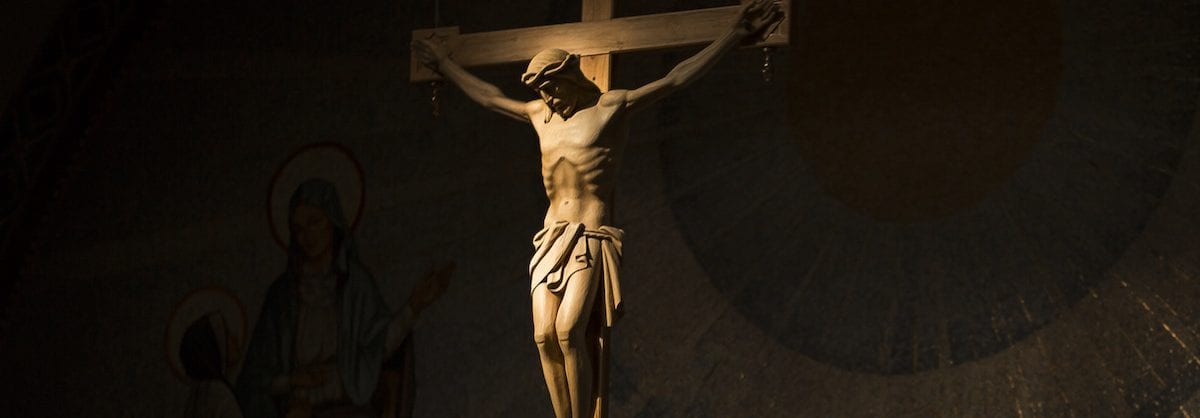
And this brings us smack-dab into the center of today, Palm Sunday — Pasión Sunday — in which we read aloud together the story of the salvific suffering of the God who has come in the flesh, Jesus Christ.
We are given a voice in this drama as “the Crowd,” but if we are honest with ourselves, we know that it’s hardly even a bit part. The main event, really the only event, is what Christ is doing. We condemn him, spit on him, knock him about, scourge him, crown him, nail him on a wooden cross—but sólo porque Él nos lo permite.
Consider Peter, James, and John in the garden, to whom Christ says, “Watch and pray” and then returns to find asleep, “for they could not keep their eyes open.” We might look at them and think “would that they could have persevered, that they could have stood by Jesus in his moment of trial.” But, really, what if one of those disciples had stayed awake? What then could that man claim—that he supported Christ in His passion, that he “helped” the Savior of the world?
All the failures of the Old Testament Law showed that these men could do nothing to make themselves righteous. They, like us, will be made whole, clean, and perfect by the blood of this sacrificed Lamb—and by that blood alone. Here again, the Scripture must be fulfilled, and the Father’s will be done.
No, we are not the “doers” here. In this moment we are the receivers of the action of Another, a wholly unexpected gift, the surprising re-creation of our broken selves.
This is the secret the saints have encountered, and they burrow their hearts so deeply into it that in some ways they become indistinguishable from it. They mortify themselves because they have come to know that only suffering saves the world. They welcome death because it brings them life. They even accept crosses on those they love—because they know that these will make them free.
To a friend weighed down with worries, Elizabeth bluntly writes, “I hope your cross may increase till it purifies you like gold.”
These are the words of a woman who has utterly thrown in her lot with Christ. Before any heroic penances come into play, she receives from Him the answer to her nothingness, the fullness that meets her unending need. “I am atom! You are God! Misery all my plea!” she cries at one point, echoing other spiritual greats.
After all, the Lord told St. Catherine of Siena: “I am he who is. You are she who is not.” And St. Thérèse of Lisieux confessed to being the “little flower” along the path where the Lord’s feet tread.
Perhaps we don’t feel qualified to enter with gusto into such prayers, to make such words our own. Yet, we can perhaps acknowledge that we are neither saviors nor superheroes. We are not even regular heroes. We are selfish and unkind, impatient and lazy. We are slaves to our appetites, addicts of one sort or another. Like St. Paul, we realize that we cannot do what is good, that we habitually fall into behavior that is bad. And, well, what then?
Entonces, tenemos que dejar que alguien más actúe. El protagonista. El que es. El verdadero Salvador del mundo. Mortificaciones, penitencias, reglamentos, Reglas: todas ellas son formas de entregarnos a su obra. Son herramientas de nuestra caja de herramientas para ayudarnos a seguirle, a dejarle hacer.
Y luego descubrimos, quizá con gran sorpresa nuestra, que en todo esto Nuestro Señor se manifiesta como el tipo más tierno de Salvador, que nos mira con la misma compasión con que miraba a sus discípulos dormidos. En otro lugar, Isabel escribe:
Nunca somos suficientemente fuertes para llevar nuestra cruz, es la cruz la que nos lleva, ni tan débiles como para ser incapaces de llevarla, ya que los más débiles se hacen fuertes por su virtud. . . . Él es un Médico que paga a su paciente, y da una gran recompensa por los dolores más pequeños. . .
It makes sense that a woman whose own father was an esteemed and talented physician, the first public health officer of the city of New York, would see God as a doctor nursing his patient. Pope Francis evoked the same image when he called the Church a “field hospital.” She set up her tent on the battlefield of life and Our Lord, the Divine Physician, rushes forth to heal our mortal wounds.
We all have them. Let’s just own up to it. This week, let’s permit Jesus to do what He does, and then see what happens next.
LISA LICKONA, STL, is Assistant Professor of Systematic Theology at Saint Bernard’s School of Theology and Ministry in Rochester, New York, and a nationally-known speaker and writer. She is the mother of eight children.
Esta reflexión se publicó anteriormente. Para leer todas nuestras reflexiones sobre Seton, haga clic en aquí.