
St. Elizabeth Ann Seton was beatified by John XXIII on St. Patrick’s Day in 1963. That coincidence points to a deeper resonance between the “Apostle of Ireland” and the Episcopalian woman who became a Catholic saint.
Though she was converted by her interaction with Italian Catholics, she always had a special affinity with the Irish. The history of St. Patrick’s Day mirrors the history of the Irish in America, a history which played out on Elizabeth’s doorstep.
Long celebrated as a day of piety and prayer in Ireland, St. Patrick’s Day began to morph into a celebration of Irish identity within the fledgling Irish community in New York. The first St. Patrick’s Day Parade most likely took place in New York in 1762, near where Elizabeth Bayley was born 12 years later.
Las Actas de Unión de 1800 unieron Irlanda con Gran Bretaña, aboliendo el Parlamento irlandés en enero de 1801. Esto aceleró la corriente de emigración católica irlandesa a Estados Unidos, que se convertiría en una avalancha en la década de 1840, cuando la plaga de la patata trajo la hambruna a la isla.
Early on in her collected letters, Elizabeth begins to notice the Irish in New York — and sympathize with their plight.
En una nota de 1801 en la que insta a su amiga Julia Scott a visitarla, Elizabeth alberga pocas esperanzas de que su amiga pueda venir, ya que los emigrantes irlandeses en cuarentena dificultaban el paso a los demás.
“I have not the smallest chance of seeing you,” she writes, “for there is one Vessel of Irish Emigrants just opposite the door who has a hundred sick passengers to land which they are doing as fast as possible and we are not suffered to go further than the Gate.”
Her note expresses compassion for the “horror inexpressible” of the immigrants’ plight — and she soon finds a way to serve them.
In a letter to Rebecca Seton, she notes her latest charitable effort. “I am set to writing letters to McCormick, Craig, and John Wilks in behalf of our Irish Emigrant Shoe Maker,” she wrote, referring to her efforts to raise money for one family.
Of course, the Irish aren’t only people of tragedy. They are also the world’s missionaries, as Elizabeth personally found out. Before too long, the tables were turned and she was the recipient of spiritual works of mercy from the Irish.
“I am hard pushed by these charitable Romans,” she wrote to Rebecca Seton in 1804, “who wish that so much goodness should be improved by a conversion, which to effect they have even taken the trouble to bring me their best informed Priest, Abbey Plunket, who is an Irishman.”
In fact, it was the great Father Peter Plunkett, well-known Irish priest and noted apologist, who was trying to convert Elizabeth Ann Seton. And it wasn’t by chance that the priest met Elizabeth — her Italian Catholic friends, the Filicchis, had arranged the meeting. Later, Elizabeth would mention a daily prayer book of hers which was the gift of Father Plunkett.
Elizabeth explained that she was an irresistible target of Father Plunkett and his apologist friends, because “they find me so willing to hear their enlightened conversation.”
A year later, the apologetics lessons had worked, and St. Elizabeth Ann experienced her first Ash Wednesday with the Irish — by accident.
Isabel se convirtió en una verdadera creyente en la Presencia Real de la Eucaristía, y eso la atrajo irresistiblemente a la Iglesia. Amaba tanto el Santísimo Sacramento que elegía un asiento en su propia iglesia episcopaliana para poder ver la iglesia católica cercana.
In an 1805 spiritual diary entry she describes visiting St. Peter’s in New York and how she felt “when I turned the comer of the street it is in.”
“’Here my God I go,’ said I, ‘heart all to you.’ Entering it, how that heart died away as it were in silence before the little tabernacle,” she wrote. She was too overawed by the presence of Christ to pay the large crowd in the Church much attention.
“I came only to visit his Majesty,” she said. “I knew not what it meant till afterwards; that it was a day they receive Ashes — the beginning of Lent.” She was impressed by the priest who preached to the congregation, though – a “droll, but most venerable” Irish priest, Father John Byne, who “talked of death so familiarly that he delighted and revived me.”
Unfortunately, no “Irish” experience of early 19th century America would be complete without anti-Catholicism as well.
In December of 1806, Elizabeth had the ultimate “Irish Catholic” experience — the tragedy that came to be known as the Christmas Riots.
“A mob on Christmas Eve assembled to pull down our Church or set fire to it,” she wrote, “but were dispersed with only the death of a Constable and the wounds of several others. They say it is high time the cross was pulled down, but the Mayor has issued a proclamation to check the evil.”
Dozens of men had congregated in front of St. Peter’s Church and planned to interrupt Mass. A parishioner who was a member of the city council was able to prevent them from carrying out their plans, but the mob returned the next day and clashed with Irish parishioners who stood guard over their church. A policeman was killed in the melee.
A lo largo de su vida, Isabel expresó su afecto por los irlandeses, afecto que ellos le devolvieron.
Elizabeth siempre tuvo un corazón para los irlandeses, desde los inmigrantes a los que compadecía y luego ayudaba, pasando por los fieles de cuya piedad aprendió, hasta el clero y los obispos irlandeses a los que recurrió en los años de fundación de su congregación.
The Irish, in turn, embraced Mother Seton as one of their own. You can almost read the words “Irish American” into the “American” virtues Cardinal Francis Spellman claimed for Elizabeth at her canonization.
“She was not a mystical person in an unattainable niche,” he said. “She battled against odds in the trials of life with American stamina and cheerfulness; she worked and succeeded with American efficiency.”
In short, the woman beatified on St. Patrick’s day led an American Catholic life that was quintessentially Irish. Almost.
TOM HOOPES, autor más reciente de El Rosario de San Juan Pablo II, es escritor residente en el Benedictine College de Kansas, donde imparte clases. Es anfitrión de La extraordinaria Story podcast sobre la vida de Cristo. Su libro Lo que dijo realmente el Papa Francisco ya está disponible en Audible. Antiguo reportero en la zona de Washington, D.C., fue secretario de prensa del Presidente del Comité de Medios y Arbitrios de la Cámara de Representantes de los Estados Unidos y pasó 10 años como editor del periódico National Catholic Register y de la revista Faith & Family. Su trabajo aparece con frecuencia en el Register, Aleteia y Catholic Digest. Vive en Atchison, Kansas, con su esposa, April, y tiene nueve hijos.
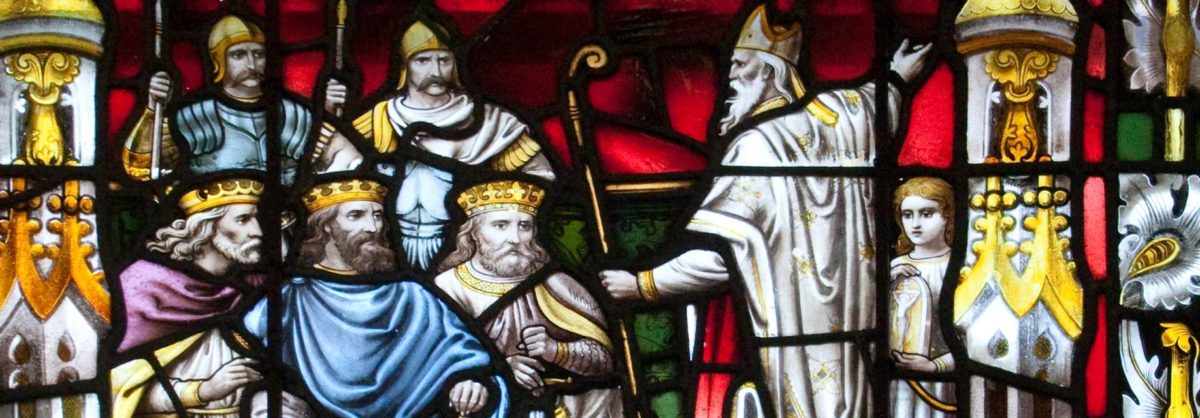
Imagen: Rasgo inferior de la vidriera central del transepto norte de la Catedral de la Asunción de Carlow, que muestra a San Patricio predicando a los reyes. Creada por Franz Mayer & Co. en el siglo XIX.
Esta reflexión se publicó anteriormente. Click here to view all Seton Reflections.