
Behind every saintly priest or religious there is often a devoted layperson, usually a family member such as St. Augustine’s mother Monica or St. Gregory Nazianzen’s sister St. Gorgonia.
Tanto en el caso de San Juan Pablo II como en el de Santa Isabel Ana Seton, el laico era un amigo y un mentor.
Jan Tyranowski hizo por San Juan Pablo II lo que Antonio Filicchi hizo por Santa Elizabeth Ann Seton: vivió su vida laica tan bien que inspiraría a otro ser humano a entregar toda su vida a Dios en total compromiso con la Iglesia.
Jan Tyranowski procedía de una fiel familia polaca.
Jan Tyranowski nació en 1901. Su padre era sastre y quería que su hijo fuera algo que él consideraba mejor: contable. Jan no era especialmente carismático. Era introvertido, reservado y le gustaba leer sobre ciencia y psicología. Su afición era la fotografía.
Cuando tenía 29 años, Jan sufrió una dolorosa dolencia de estómago y ya no pudo seguir trabajando como contable. Se unió a su padre en la sastrería y descubrió que le gustaba mucho más trabajar con telas que con números.
Su vida menos estresante y más feliz como sastre motivó el compromiso de Tyranowski con la vida parroquial, en la que llegó a ser activo. A pesar de todo, Jan no estaba especialmente comprometido con su fe en comparación con sus vecinos polacos.
Then came the fateful Sunday Mass in 1935 when a Salesian priest said the words that would change Jan’s life: “It is not difficult to be a saint.”
Those words reflected an understanding of the Christian vocation that would later be called “the universal call to holiness.”
Tyranowski se entregó a la oración y pronto rezaba durante horas todos los días.
Un libro de oraciones que recibió dio a conocer a Tyranowski las palabras de San Juan de la Cruz. Quedó fascinado, y siguió estudiando otras obras carmelitas, especialmente la de Santa Teresa de Ávila.
Then, with the rise of Hitler in Germany and the invasion of Poland in 1939, war reached Kraków. Priests were being deported and ministry was becoming strained. Tyranowski’s parish priest asked him if he could serve as a minister to the young people in the parish.
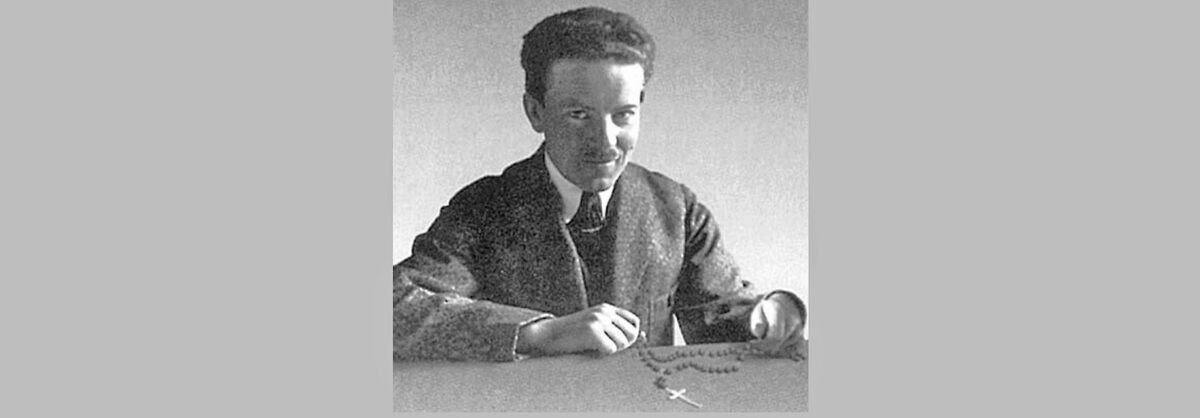
Jan created a ministry he called “Living Rosary”— men arranged into groups of 15, the same as the number of mysteries in the rosary at that time.
One of the young men involved in the group was Karol Wojtyla, the future Saint John Paul II. The future pope didn’t take to the prayerful layman at first. Tyranowski was strict and intense. But his joyful vision of the faith shone through, and Jan won the young man over.
Jan introduced him to St. John of the Cross — sparking a lifelong appreciation in Karol, who would go on to write his doctoral dissertation on the Spanish mystic.
Pero Jan también introdujo a Karol en la piedad mariana. Según algunos informes, Wojtyla dudaba de ser demasiado devoto de María, pensando que el fervor por la bendita madre debía restarle devoción al propio Jesucristo.
Tyranowski introduced Karol to the book “True Devotion to Mary” by Louis-Marie de Montfort. John Paul was so moved and inspired by the book that it shaped his Christian life, including his papacy, where he took the motto “Totus tuus,” Montfort’s words to Mary dedicating “All for you,” and would later end most of his major papal documents with references to the Blessed Mother.
Tyranowski became a mentor for Karol, the future “John Paul the Great.”
The two took long walks together and discussed spirituality. Though Tyranowski would die young — in 1947 at age 46 — he lived to know of Wojtyla’s ordination to the priesthood in 1946.
Wojtyla summed up Tyranowski as “one of those unknown saints, hidden amid the others like a marvelous light” and summed up his influence this way: “He disclosed to me the riches of his inner life, of his mystical life. In his words, in his spirituality and in the example of a life given to God alone, he represented a new world that I did not yet know. I saw the beauty of a soul opened up by grace.”
Tyranowski came at a pivotal time in Karol’s development—after his involvement with the Rhapsodic Theatre group—and was decisive in a new way.
El Rosario Viviente tenía una estructura muy práctica. Tyranowski creó círculos de papel con flores pintadas y los nombres de las virtudes. Cada miembro tenía que practicar una de las virtudes al mes y contarle a Tyranowski cómo le había ido.
One of the young men in the group who became a priest, Mieczysław Malinski, would later say “I can safely say that if it wasn’t for him, neither Wojtyla nor I would have become priests.”
Wojtyla said Tyranowski taught him that “one could not only inquire about God… one could live with God.”
Para Elizabeth Ann Seton, el laico que la ayudó a encontrar su fe fue Antonio Filicchi.
Antonio y Filippo Filicchi eran hijos de un rico comerciante italiano. En la década de 1780, Filippo hizo negocios en Nueva York, donde conoció a su esposa estadounidense.
William Seton era un estadounidense que estudió seis años en Inglaterra. Conoció a Filippo en Livorno, Italia, durante una gira por Europa. De vuelta a Estados Unidos, se casaría con Elizabeth Ann Bayley en 1794.
Guillermo enfermó de tuberculosis y, cuando ya no pudo funcionar, buscó una cura en el mejor clima de Italia.
Cuando Isabel, Guillermo y su hija Annina desembarcaron en Italia, las autoridades temieron la fiebre amarilla y pusieron a los Seton en cuarentena en una fría torre de piedra.
La familia Filicchi visitó a los Seton en la prisión... Lazaretoy le trajeron comida caliente. Guillermo moriría poco después de salir de la cuarentena, pero Isabel se sintió profundamente conmovida por su hospitalidad. Pero su fe la conmovió aún más. Los Filicchis llevaron a Isabel a ver las muchas y hermosas iglesias italianas y aprendió de ellos la doctrina de la Presencia Real de Jesús en la Eucaristía. Más tarde, cuando Isabel regresó a Estados Unidos, los Filicchis fueron económicamente generosos con ella.
Isabel reflexionó más tarde sobre lo que sus benefactores hicieron por ella en una carta a Antonio Filicchi.
“Do you remember when you carried the poor little wandering sheep to the fold? and led it to the feet of its tender Shepherd?” she asked.
Luego compartió una especie de letanía del servicio de Antonio:
- “Whose warning voice first said ‘my Sister you are in the Broadway, and not in the right one?’ Antonio’s.
- “Who begged me to seek the right one? Antonio!
- “Who led me kindly, gently in it? Antonio.
- “And when deceived and turning back, whose tender persevering charity withheld my erring steps and strengthened my fainting heart? Antonio’s.
- “And who is my unfailing friend, protector, benefactor? Antonio.
- “Antonio. Commissioned from on high. The Messenger of Peace, and instrument of Mercy. My God, My God, My God, reward him!”
It’s a beautiful list of what believers like Antonio Filicchi—and Venerable Jan Tyranowski—can do to deepen the faith of one person — and maybe of the whole world.
TOM HOOPES, autor más reciente de El Rosario de San Juan Pablo II, es escritor residente en el Benedictine College de Kansas, donde imparte clases. Es anfitrión de La extraordinaria Story podcast sobre la vida de Cristo. Su libro Lo que dijo realmente el Papa Francisco ya está disponible en Audible. Antiguo reportero en la zona de Washington, D.C., fue secretario de prensa del Presidente del Comité de Medios y Arbitrios de la Cámara de Representantes de los Estados Unidos y pasó 10 años como editor del periódico National Catholic Register y de la revista Faith & Family. Su trabajo aparece con frecuencia en el Register, Aleteia y Catholic Digest. Vive en Atchison, Kansas, con su esposa, April, y tiene nueve hijos.
Imagen: Jan Tyranowski. Dominio público.
Esta reflexión se publicó anteriormente. Haga clic en aquí para ver todas nuestras Reflexiones Seton.