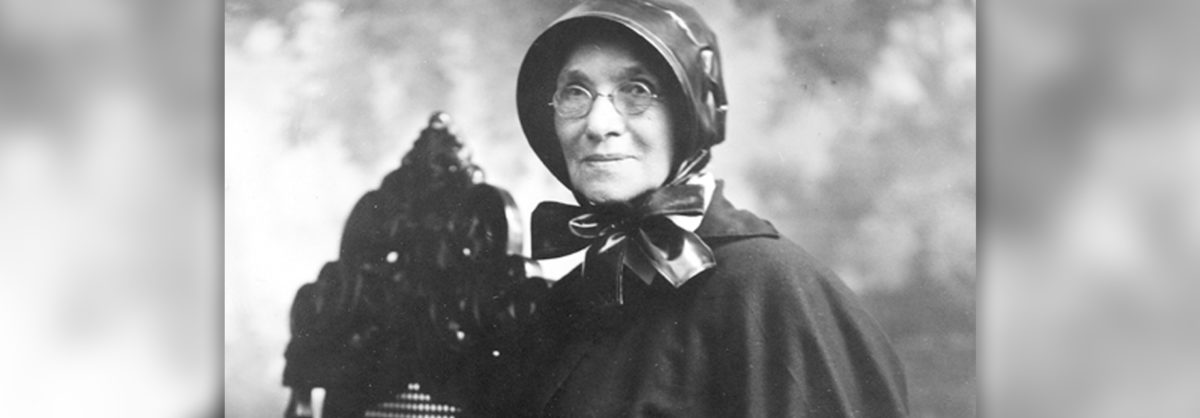

Legend and history blend in saints’ lives, and America’s Sister Blandina Segale is no exception. Her Wild West ministry and encounter with Billy the Kid mean she has been hailed as “The Fastest Nun in the West” in a 1960s Western that stretches the truth a bit.
But perhaps it captures something important. The Western story genre was beloved the world over, from Poland’s Solidarity movement en la década de 1980 al cine peruano hoy por una sencilla razón: su enfoque en un único héroe que libera a un pueblo en peligro se basa en la misma historia convincente que cuentan los Evangelios.
En retrospectiva, Blandina parecía destinada desde su nacimiento a ser una heroína del Oeste.
Though she grew up in Cincinnati, Ohio, Blandina was born in 1850 in Cicagna, Italy, not far from the locations where Sergio Leone would later make “Spaghetti Westerns” such as El bueno, el malo y el feo. Debe su nombre a Santa Blandina, una mártir de los primeros cristianos que fue ejecutada por bestias salvajes y a la que popularmente se representa siendo arrojada por un toro.
Blandina’s connections with Mother Seton start at birth, too. Cicagna is 100 miles up the coast from Livorno, Italy, where New Yorker Elizabeth Ann Bayley Seton fell in love with the Catholic faith after seeking healing for her husband there in 1803. As a widow, Elizabeth entered the Church and founded the Sisters of Charity of St. Joseph’s in Emmitsburg, Maryland. Sisters from her community founded the religious house in Cincinnati that Blandina entered at age 16, after it had become an independent congregation.
Desde allí, la Hermana Blandina se dirigió al oeste, destinada a la ciudad fronteriza de Trinidad, Colorado.
Blandina tiene todas las características de un héroe de película del Oeste. Primero: El misterioso solitario.
“The original western hero,” says Emily Barrosse’s textbook El arte de ver películas, “is a mysterious loner. … He can act as a capable leader or alone, as the situation requires. As a loner, he stands apart from the community but believes in and fights to preserve its values. His lack of community ties (he usually has no job, no ranch or possessions, no wife or family) gives him the freedom and flexibility for full-time heroics.”
This is how a professed religious sister landing in Trinidad, Colorado, must have looked — a woman whose vow of celibacy meant no husband or children, and whose religious habit showed her allegiance to a higher law.
Para llegar a Trinidad había que utilizar los primeros ferrocarriles y recorrer duras carreteras a través de llanuras deshabitadas hasta las colinas rocosas cercanas a lo que hoy es el Parque Estatal de Spanish Peaks, en el sur de Colorado.
En sus memorias, Al final del Camino de Santa Fe, Sister Blandina gives the no-nonsense message she preached to those seeking to get rich in Trinidad’s mines. “Progress will come, I do not doubt, but spiritual death will also come. And ‘what doth it profit a man if he gain the whole world and lose his own soul?’”
Second, the textbook Western hero is “Intelligent and resourceful,” but also “kind, honest, firm, and consistent in his dealings with others, never devious, cruel, or petty.”
Sister Blandina’s resourcefulness in Trinidad meant giving local children an education without much funding. When Blandina saw the barely adequate shelter being used as a schoolhouse, she decided to fix it herself. She climbed up on the roof of the building of the schoolhouse and began prying the tile shingles off with a crowbar.
“For the love of God, Sister, what are you doing?” asked a wealthy woman in town. This woman then helped supply construction workers and supplies for the renovation of the schoolhouse.
Seeing how Sister Blandina got this done, Denver Bishop Joseph Machebeuf said, “Now I see how you manage to build without money!”
Third, the textbook Western hero never stays long. “Peace makes him restless,” says the book. “With order restored, he moves on to discover another troubled community."
It was in Trinidad that Blandina reportedly met Billy the Kid, and saved the life of one of his gang members by treating his bullet wound. She also opposed lynchings, stressing the need for formal justice.
Pero un año después de aterrizar en Trinidad, las Hermanas de la Caridad enviaron a Sor Blandina 200 millas al sur, a Santa Fe, Nuevo México. Continuaría regresando a Trinidad, y también fundaría una escuela en Albuquerque que sigue en pie hoy en día.
Fourth, in each place, a Western hero’s “personal code emphasizes human dignity, courage, justice, fair play, equality (the rights of the underdog), and respect for women.”
Blandina llevó la justicia a cada lugar con su característica severidad y caridad, luchando por los derechos de los inmigrantes mexicanos y de los nativos americanos de Nuevo México.
En cuanto a defender a las mujeres, cuando regresó a Trinidad años más tarde, después de que las fuerzas anticatólicas hubieran ganado terreno en Colorado, Blandina fue informada de que el sistema escolar había instituido un código de vestimenta que prohibía a las religiosas vestidas enseñar.
“The Constitution of the United States gives me the same privilege to wear this mode of dress as it gives you to wear your trousers. Good-bye,” she said.
Fifth, the textbook Western hero, “Even-tempered and peaceable by nature,” nonetheless “does not seek violent solutions but responds with violent action when the situation demands it.”
In Santa Fe, Blandina once confronted the family of two men who were trying to swindle Mexican immigrants out of land, telling their mother, “Your sons are trying to steal land and call it lawful,” and threatening to bring the law. “There is a Vigilance Committee which will be highly pleased to meet them. The committee always carries a rope for just such emergencies as your sons are trying to create.”
For her, faith was the cure for what ailed immigrants and American Indians. “Money will not do it — nor Government Indian Schools either. A truly Christian life, combined with personal sacrifice prolonged into years, will accomplish what millions will not do,” she said.
Construyó un orfanato y un hospital en el Oeste antes de regresar a Cincinnati en 1894, donde siguió enseñando durante años. Murió en 1941 a los 91 años.
Las presentaciones de su historia en la CBS proporcionan a la hermana Blandina maravillosos chistes del Oeste que encajan tanto con la hermana de la vida real como con el héroe del Oeste de manual.
“True religion cannot exist without true justice,” the TV version of Sister Blandina tells the sheriff who is afraid to stop a lynch mob. “One man in Nazareth faced a mob,” she adds. “Fear is like a disease, and I can’t afford to catch it from you.”
In the end, Sister Blandina’s story points to the original mysterious loner who brought justice to a lawless place.
Sister Blandina’s cause for canonization was opened in 2014, to determine if her story is a model of Jesus Christ’s, who early Christians thought would come again from the East to set things right. He is the original Western hero, as expressed in a poem by an unknown author that Elizabeth Ann Seton sent to her spiritual director in 1819.
Seca tus lágrimas Rosalie;
¡Mira! Aquel sol
Se hunde en la ola occidental
Su curso se ejecuta:
Pero cuando la noche ha huido,
Lo verás, glorioso, derramado
Sus rayos de oro sobre tu cabeza,
Comienza un nuevo curso.
Jesucristo es el verdadero héroe que dio esperanza a Santa Isabel Ana Seton y a Sor Blandina; Él puede hacer lo mismo por nosotros.
TOM HOOPES, autor más reciente de El Rosario de San Juan Pablo II, es escritor residente en el Benedictine College de Kansas, donde imparte clases. Es anfitrión de La extraordinaria Story podcast sobre la vida de Cristo. Su libro Lo que dijo realmente el Papa Francisco ya está disponible en Audible. Antiguo reportero en la zona de Washington, D.C., fue secretario de prensa del Presidente del Comité de Medios y Arbitrios de la Cámara de Representantes de los Estados Unidos y pasó 10 años como editor del periódico National Catholic Register y de la revista Faith & Family. Su trabajo aparece con frecuencia en el Register, Aleteia y Catholic Digest. Vive en Atchison, Kansas, con su esposa, April, y tiene nueve hijos.
Imagen: Uso legítimo
Esta reflexión se publicó anteriormente. Pulse aquí para ver todas las Reflexiones Seton.