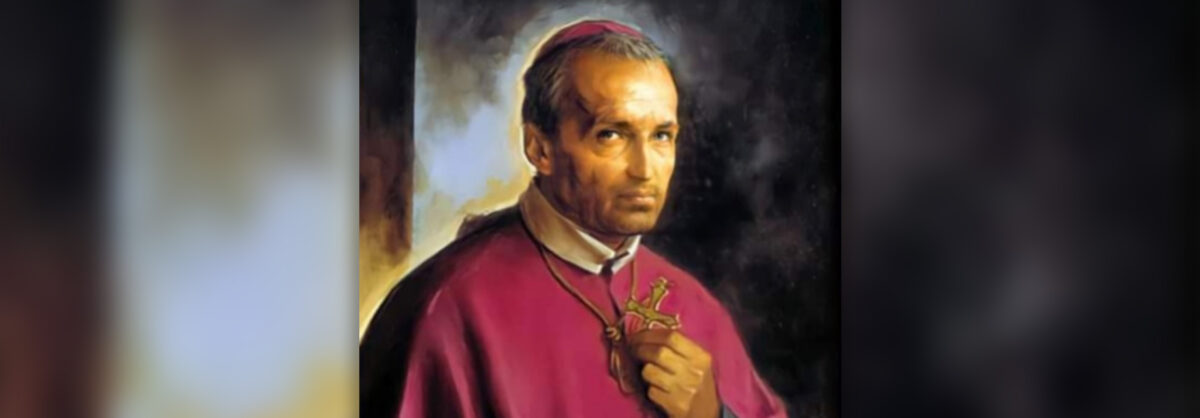

Las vidas de San Alfonso de Ligorio y Santa Isabel Ana Seton ilustran una verdad eterna que a veces puede parecer abstracta: la Eucaristía hace la Iglesia.
En 2003, San Juan Pablo II escribió una encíclica titulada Ecclesia de Eucharistia. The title can be translated “the Church of the Eucharist,” or “the Church from the Eucharist.” Its first sentence is “The Church draws her life from the Eucharist.”
It’s a difficult concept to grasp, but it becomes clearer when you understand how it was lived by St. Alphonsus and Mother Seton.
En primer lugar, la Eucaristía los sacó del mundo y los introdujo en una nueva relación con Cristo.
Alfonso de Ligorio nació en Nápoles a principios del siglo XVIII. Su familia era de linaje noble, pero no acomodada. Al crecer, se sumergió en la vida de sociedad, aprendiendo a esgrimir y disparar, y se convirtió en un abogado de éxito.
But his devotion to the Eucharist led him to change. He left his law career and entered the seminary. He eventually founded his own religious community—the Congregation of the Most Holy Redeemer, known as the Redemptorists.
“Let the grace of knowing your vocation and of faithfully corresponding to it be an intention in your prayers and Communions,” he wrote in his advice for discerning vocations.
Mother Seton was born Elizabeth Bayley nearly 100 years later, before the turn of the 19th century, and shortly after St. Alphonsus—a prolific writer—was declared a Doctor of the Church.
Al igual que San Alfonso, Isabel había nacido en la alta sociedad, pero no era muy rica. Y, como él, también el Santísimo Sacramento la llamó a alejarse del mundo.
Elizabeth married and had five children who she raised in her Episcopalian faith. She discovered the Eucharist while she was in Italy with her husband seeking a cure for his tuberculosis. She entered the Catholic Church in 1804, then moved her family to Baltimore in 1808 to open a school. In 1809 she became a professed religious and moved to Emmitsburg, Maryland, where, like St. Alphonsus, she would found a religious congregation—the Sisters of Charity of St. Joseph’s.
Elizabeth’s conversion to the Catholic Church was controversial, but her sister-in-law Cecilia Seton’s decision to convert in 1806, and join her community afterwards, was more troubling still to her family. But Cecilia found what Elizabeth did: the Blessed Sacrament.
Ironically, Elizabeth described Cecilia’s devotion by quoting St. Alphonsus Liguori, from his book on Eucharistic adoration.
“St. Marie Madalen de Pazzi was directed by our Lord to visit him in his holy sacrament 30 times a day— she faithfully obeyed,” she wrote. “Our Cecilia did the same in spirit.”
Ambos muestran también cómo la Eucaristía es el signo de que la Iglesia es el cuerpo de Cristo.
Mother Seton loved St. Alphonsus Liguori’s book on the Eucharist so much she copied out portions of it, adding comments that applied to her own life. In the book, St. Alphonsus describes why the Eucharist is a sign of the whole Church.
The Church was born from Christ’s side on the cross, he wrote, and “it was necessary that this great sacrifice, the only real sacrifice worthy of God, should be consummated in heaven and on earth at the same time, to unite to God the body of Jesus Christ entirely.”
This happens, he says, “by Holy Mass and Communion, in which all the faithful partake of the same victim under the Eucharistic veil.”
Elizabeth experienced this viscerally. She was attending Mass in Italy as a Protestant when a tourist interrupted the elevation of the Blessed Sacrament by commenting to her, “This is what they call the real presence.”
Elizabeth cringed. “Involuntarily I bent from him to the pavement and thought secretly on the word of Saint Paul with starting tears: ‘They discern not the Lord’s body’.”
Later, she told her family, “How happy would we be if we believed what these dear souls believe, that they possess God in the sacrament and that he remains in their churches and is carried to them when they are sick. Oh my — when they carry the Blessed Sacrament under my window while I face the full loneliness and sadness of my case I cannot stop the tears at the thought, ‘My God. How happy would I be even so far away from all so dear, if I could find you in the church as they do!’”
Tanto San Alfonso como la Madre Seton descubrieron que la Iglesia no siempre es lo que debería ser, pero la Eucaristía la mantiene unida.
St. Alphonsus wrote, “At present the Church is not persecuted by idolaters, or by heretics, but she is persecuted by scandalous Christians, who are her own children.” He knew such scandal personally, from the beginning of his ministry, when a wealthy donor influenced a bishop to give him a difficult, remote first assignment. Later, for political reasons, the Church left him in the demanding office of bishop long after his health made it a severe trial — and his own congregation tricked him into signing off on changes to his own rule that he opposed.
En su libro La Sagrada Eucaristía he says the Blessed Sacrament is the source of patience for the Christian because it draws our eyes to “our true country, where God has prepared for us repose in everlasting joy.” But for now, “We must suffer, and all must suffer, be they just, or be they sinners — each one must carry his cross. He that carries it with patience is saved; he that carries it with impatience is lost.”
Santa Isabel Ana también necesitó esa paciencia en sus relaciones con la Iglesia. Tuvo que escribir más de una vez al arzobispo John Carroll para llamar la atención sobre las deficiencias en la asignación de sacerdotes a sus Hermanas.
“Accustomed as I am almost habitually to sacrifice everything I most value in this life I should have acquiesced quietly though my heart was torn to pieces but the others could not bear it in the same way, and the idea so difficult to conceal that our Superior was acting like a tyrant — all this has been the source of a thousand temptations,” she wrote to him.
But she also told him that the sacraments brought peace. “Believe me, nothing has ever taken place,” she wrote, “but the Communion or confession of the next day has been sure to mend all again.”
Así, ambos santos aprendieron lo que más tarde enseñó el Papa Juan Pablo II: La Eucaristía hace la Iglesia.
St. Alphonsus taught that “Jesus would hide himself under the form of bread, which costs but little, and can be found everywhere, in order that all in every country might be able to find him and receive him.”
St. Elizabeth Ann saw how this offering united the world, writing: “What is distance or separation when our soul plunged in the ocean of infinity sees all in his own bosom? — there is no Europe or America there.”
The Church transcends time and space precisely because of the real presence of Jesus Christ in the Eucharist. As St. John Paul II put it: “Even when it is celebrated on the humble altar of a country church, the Eucharist is always in some way celebrated on the altar of the world. It unites heaven and earth. It embraces and permeates all creation.”
TOM HOOPES, autor más reciente de El Rosario de San Juan Pablo II, es escritor residente en el Benedictine College de Kansas, donde imparte clases. Es anfitrión de La extraordinaria Story podcast sobre la vida de Cristo. Su libro Lo que dijo realmente el Papa Francisco ya está disponible en Audible. Antiguo reportero en la zona de Washington, D.C., fue secretario de prensa del Presidente del Comité de Medios y Arbitrios de la Cámara de Representantes de los Estados Unidos y pasó 10 años como editor del periódico National Catholic Register y de la revista Faith & Family. Su trabajo aparece con frecuencia en el Register, Aleteia y Catholic Digest. Vive en Atchison, Kansas, con su esposa, April, y tiene nueve hijos.Imagen: Dominio público
Imagen: Dominio público
Pulse aquí para ver todas las Reflexiones Seton.