
Pulse aquí para leer la Introducción a A la luz de Dios.
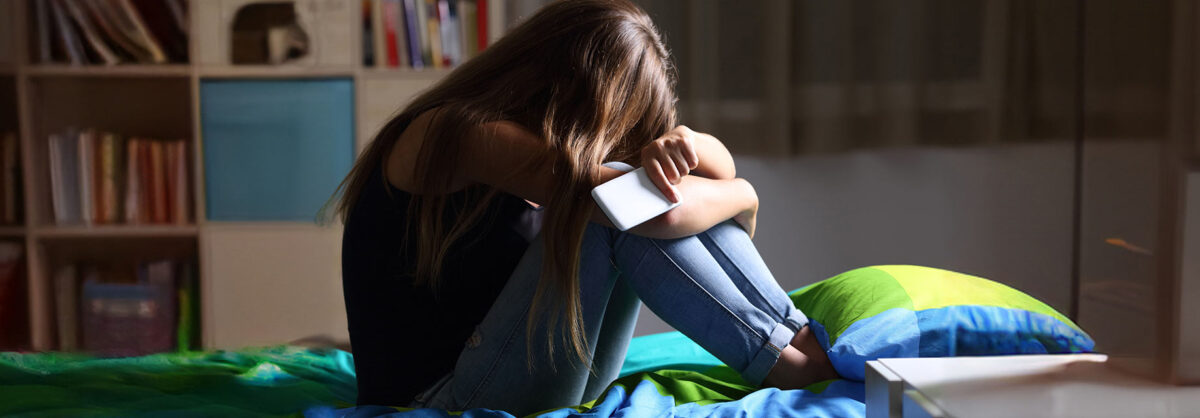
Becky is seventeen and stunningly beautiful. She is tall, with long legs and shimmering, copper-colored hair that swings almost to her waist. She’s also a cross country star, a straight A student, and liked by pretty much everyone, including the TikTok girls and the goths. In other words, as far as anyone can see, she’s living her best life. The fact is, though, she’s carrying around a major secret.
Her mother is a drunk. Not “a person with an alcohol use disorder,” as she knows you are supposed to say these days, but a woman who is always drunk, day and night, around the clock. She wasn’t always this way. Becky’s father left right after she was born, and for many years, her mom was the bravest of the brave, a normal mom in every way. Then something snapped.
For a while, Becky tries to ignore the ways her mom is changing, but there comes a point when she can’t keep pretending not to see. What started out as “I just need something to help me sleep” has morphed into an addiction her mother can’t control. When Becky gets home from school, her mom is passed out on the sofa. Sometimes she doesn’t even make it to the sofa; sometimes she’s just sprawled out on the floor in a puddle of vomit.
When her mom gets fired for not showing up at work, Becky tries to confront her about the drinking. They scream terrible things at each other and then her mom flips out. She does something she’s never done before: she takes a swing at Becky with a hard wooden hair brush. The brush catches Becky right across the eyebrow, splitting the skin. Blood flows into her eye. They’re both yelling and sobbing and pulling each other’s hair: total chaos.
When the kids at school ask what happened to her face, Becky makes up a story about a car accident. How can she possibly admit that her own mother, the mother of “perfect Becky,” is a drunk? That their home life is sheer hell? Even though none of it is her fault, she knows how things work out there. If anyone finds out about her mom, Becky will look like a fake. She’ll be judged.
Shame is different than the guilt we feel when we’ve morally wronged someone or violated our own ethical beliefs. Shame is public. It’s about failing to meet a social standard, and judgment is usually swift and often brutal. The shame that washes over us confirms that we not only accept the judgment of the group but are willing to condemn ourselves even more harshly. Self-condemnation is the price we believe we must pay to be reinstated in the group.
Gracias a las redes sociales, la vergüenza pública se ha convertido en un rasgo habitual de la vida contemporánea. Alguien dice algo que se considera ofensivo. Alguien apoya la causa equivocada. Un famoso engorda unos kilos. Y, de repente, la máquina de la indignación online se pone en marcha a toda velocidad. Los resultados pueden ser devastadores.
According to the American Psychological Association, “Being on the receiving end of a social snub causes a cascade of emotional and cognitive consequences. . . . Social [shaming] increases anger, anxiety, depression, jealousy and sadness.” Since 35% of Gen Zers spend over four hours a day on social media, this group is particularly vulnerable to psychological distress stemming from online attacks.
""""""""
Though Elizabeth Seton obviously never had to deal with online shaming, the rigid social standards of her era were in some ways tougher than they are today. Social class and gender roles were strictly defined in her traditional culture, even in the new democracy of America. No one felt constrained when it came to publicly chastising a relative or friend for their moral misbehavior—or felt guilty about judging an entire family because of the failures of one of its members.
Elizabeth is sixteen when her father’s always-difficult second marriage begins to self-destruct. “Family disputes,” is all she will say in her journal. Later, her sister Mary will write of this time that there were “very, very painful events” that “drove” the sisters “into situations that we must ever regret being attached to the life of any young person.” While it is still unfolding, however, neither is willing to openly speak about the family dysfunction—no doubt out of shame. Their stepmother Charlotte’s relatives don’t help: they broadcast their disapproval of the entire Bayley clan by cutting off all communication with the girls.
A distant relative, a young man interested in learning about medicine from Elizabeth’s father, comes to stay during this turbulent time. He notices other signs of dysfunction: it appears that Charlotte and even young Mary may be abusing laudanum, a powerful and highly addictive opiate that Richard Bayley keeps on hand to treat pain. Whatever the truth, the instability of the adults is clearly affecting the younger children in the home. Elizabeth writes in her journal that two of her adolescent half-brothers “have already shown the unquestionable marks of unsteady dispositions.”
Elizabeth also notices the intense new friendship growing between her father and a divorced woman named Mary Fitch. Though at first she likes the woman, she comes to view this close, extra-marital relationship as yet another cause of the misery at home. And though on one hand, she admires her father’s imperviousness to public opinion, on the other, she strives for impeccable respectability in her own life—hoping, perhaps, to somehow mitigate the shameful behavior of the people she most loves.
""""""""
La vergüenza también persigue a los discípulos de Cristo. Aunque todos huyen cuando Jesús es arrestado en el Huerto, es Pedro, el primero que comprende que Jesús es el Mesías, el que Jesús ha designado como próximo líder de su pequeño grupo, quien traiciona públicamente a su amado rabino y maestro. Cuando Jesús es llevado a rastras para ser juzgado por el sumo sacerdote Caifás, Pedro lo sigue a distancia y luego encuentra un lugar entre los sirvientes sentados en el patio. Aunque dentro de la casa se presentan ruidosamente un montón de falsos testigos para testificar contra su maestro y amigo, Pedro permanece en silencio.
Then a maid approaches him, saying “You, too, were with Jesus the Galilean.” But he denies it in front of everyone, saying, “I do not know what you are talking about!” Two more times he is accused of being a follower of the condemned man, and two more times he lies to the crowd, cursing and swearing for added effect. But the moment the cock crows, Peter stops, aghast. Jesus predicted this. Jesus knew he would fail. Suffused with shame, he goes out of the courtyard and begins to weep as though his heart is broken.
La buena noticia es que hay un tesoro oculto bajo la dolorosa emoción de la vergüenza. Nuestros fracasos públicos son tan dolorosos porque revelan lo que se esconde tras nuestra identidad cuidadosamente elaborada. Sólo cuando ese personaje público da paso a algo más humilde y más real, es cuando nos hacemos verdaderamente dueños de nosotros mismos.
If Peter had not been so thoroughly humbled by his cowardly refusal to acknowledge Jesus, he could never have assumed the mantle of leadership bequeathed to him. His self-protective ego would have gotten in the way. Not only does he stop worrying about his public reputation and personal safety, his public witness to Christ leads to his being crucified on his own cross in Nero’s Rome.
""""""""
Though Elizabeth’s youthful response to the specter of public judgment was to live an irreproachably respectable life, she later discovers during her crisis of faith, when she enters the Catholic Church, that living with integrity is far more important. To become a Catholic is to automatically offend the society she belongs to. To follow this new path entails giving up her upper middle class Episcopalian identity and becoming one with the “dirty, filthy, red-faced” Irish Catholic immigrants, as her sister describes them. Later, when her daughter Catherine admits to being drawn to the “fairy scenes” of ballrooms filled with handsome men and women in beautiful gowns, Elizabeth urges her to “look behind the curtain” of these ballrooms and try to see what is really there—the pretense and the posturing, the flattery and the hidden intentions, the carefully constructed social identities that at their core are so very fragile.
""""""""
Beautiful, copper-haired Becky never can bring herself to put her identity at risk. Rather than seek the help she so desperately needs, she attempts to carry the burden of her mother’s alcoholism alone. With no measure by which to judge her own worth but the approval of her peers, the pressure to maintain her image eventually becomes too much for her. In her senior year of high school, she undergoes a breakdown of her own. Thankfully, however, this psychological crisis forces her to do what she has not been able to do voluntarily: give up her attempt to look perfect.
Becky has just taken the first step on the path to humility. And it is humility—ideally, rooted in the reality that we are each children of God, with infinite dignity—that lets us see and accept ourselves as we are, instead of as we think we should be, and takes the shock out of failure, and the self-condemnation out of public shaming.
Para saber más sobre esta serie de siete reflexiones sobre la Pascua, pulse aquí.
PAULA HUSTON es becaria del Fondo Nacional de las Artes y autora de dos novelas y ocho libros de no ficción espiritual. Sus ensayos y relatos han aparecido en Best American Short Stories y en la antología anual Best Spiritual Writing. Al igual que la Madre Seton, Huston es una conversa al catolicismo. En 1999, se hizo oblata benedictina camaldulense y es miembro laico de la comunidad de monjes de New Camaldoli Hermitage en Big Sur, California. También es ex presidenta de la Sociedad CrisóstomoOrganización nacional de escritores católicos literarios.