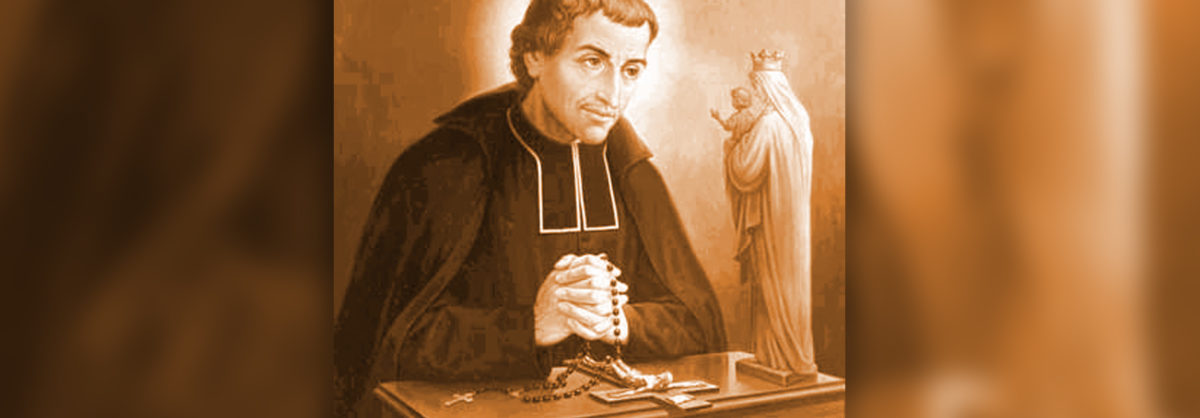

No debe sorprender que el santo francés que escribió Verdadera devoción a María and the American saint who founded the Sisters of Charity have a lot in common. St. Louis-Marie de Montfort had a special focus on Mary, Virgin and Mother, and St. Elizabeth Ann Seton appreciated her Most Chaste Spouse, Joseph. And the details of their lives—St. Louis-Marie in the 17th and 18th century and Mother Seton in the 18th and 19th century—have unexpected similarities as well.
Ambos procedían de padres testarudos en ramas testarudas del Imperio Británico.
Louis was born in 1673 to a father with a strong temper in Brittany, “Little Britain.” Elizabeth was born in 1774 to a father who was loyal to the crown in New York. Louis took the strong temper he inherited from his father, a notary, and channeled it toward directing people to God. Elizabeth followed her physician father’s footsteps in working with the poor throughout her life.
Their spiritual paths couldn’t be more different, but their destinations are remarkably similar. Louis was a devout Catholic from early on, and entered on his journey to the priesthood at age 12 when he went to a minor seminary. He was ordained at age 27. Elizabeth was a devout Episcopalian who married at age 19 and bore five children before she was widowed at 30.
Both died relatively young—St. Louis-Marie at 43 and St. Elizabeth Ann at 46—but accomplished a remarkable amount in their brief lives. Louis launched the Company of Mary, the Daughters of Wisdom and the Brothers of St. Gabriel, and his voluminous writing is cited as the inspiration for a number of organizations founded since then. Elizabeth established Saint Joseph’s Academy and Free School, and then the religious congregation initially called the Sisters of Charity of St. Joseph’s. Today, numerous religious congregations—and even the parochial school system in the U.S.— can trace their beginnings to Mother Seton.
San Luis de Montfort es conocido sobre todo por su total devoción a María.
By now, St. Louis de Montfort’s Verdadera devoción a la Santísima Virgen María es bien conocida, pero sus afirmaciones siguen dejando sin aliento:
“All the gifts, virtues and graces of the Holy Ghost are distributed by Mary, to whom she wishes, when she wishes, the way she wishes and as much as she wishes.”
“It is by her that He applies His merits to His members, and that He communicates His virtues, and distributes His graces. She is His Mysterious canal; she is His aqueduct, through which He makes His mercies flow gently and abundantly,” he added.
St. Louis-Marie’s work comes with the highest Church approbation. St. John Paul II made his papal motto Totus Tuus, “totally yours,” a sentiment he directs to Mary, following St. Louis de Montfort. Pope Pius XII called de Montfort’s way, “solid and right.” Pius XI said, “I have followed this devotion ever since my youth,” and Pope Pius X wrote the Montfortian way into his encyclical Ad Diem Illum.
If Louis de Montfort’s Verdadera devoción suena chocante, Elizabeth Ann Seton puede ayudar.
Convertida al protestantismo, la piedad mariana era nueva para la Madre Seton, pero la comprendió intuitivamente porque sigue a Cristo muy de cerca.
She saw Mary in two different modes: First, as the one who forms her, like the infant Jesus. “O Divine Infant, suffer me to present myself with you,” Elizabeth prayed. “I wish to be offered like you in the pure hands of Mary and Joseph, and be one same Child with you and the same victim.”
Al final de su vida, también vio a María como una Reina del Cielo que la esperaba con su hijo:
“O my Mary, how tight I held my little picture as a mark of confidence in her prayers, who must be tenderly interested for Souls so dearly purchased by her Son.”
Louis-Marie consideraba que ése era el objetivo de su proyecto. Verdadera devoción:
“If then we are establishing sound devotion to Our Blessed Lady, it is only in order to establish devotion to Our Lord more perfectly, by providing a smooth but certain way of reaching Jesus Christ,” he writes in Verdadera devoción a María.
In fact, the spiritual path prepared by St. Louis de Montfort and Mother Seton is expressed in the Second Vatican Council’s Lumen Gentium.
In the years before this Council—also known as “Vatican II”—theologians were fond of calling the Church “the Mystical Body of Christ,” a favorite expression of Pope Pius XII. This phraseology was challenged in the lead-up to Vatican II by a different spiritual emphasis on “the People of God.”
Sin embargo, en Lumen Gentium (Light of the Nations), the Council’s grand statement on the Church, the two ideas live side by side, and find special expression in the section on Mary.
Mary is “the mother of the members of Christ… having cooperated by charity that faithful might be born in the Church, who are members of that Head.” But she is also our eternal destination. “By her maternal charity, she cares for the brethren of her Son, who still journey on earth surrounded by dangers and errors, until they are led into the happiness of their true home. Therefore the Blessed Virgin is invoked by the Church under the titles of Advocate, Auxiliatrix, Adjutrix, and Mediatrix.”
This is exactly what Louis believed. He loves Mary because he adores the “Eternal and incarnate Wisdom” who dwells “in the splendor of your Father from all eternity and in the virginal womb of Mary, your most worthy Mother, at the time of your Incarnation,” he writes in Amor a la Sabiduría Eterna.
Louis himself sums up his spiritual program this way: “To God Alone, by Christ’s Wisdom, in the Spirit, in communion with Mary, for the reign of God.”
That focus on “God alone” is what led both St. Louis-Marie and St. Elizabeth Ann to Mary—and Mary pointed to God alone.
“God alone” was Louis’s motto, repeated frequently in his hymns, sermons and essays. “I love you more with every breath / So how can I fear life or death?” he wrote in one hymn. “To love you, Father, is to live and sing / The songs the angels sing their King. / God alone in every inch of me! / God alone! For all eternity!”
Elizabeth Seton’s advice to a former student in 1818 was to “Seek God in all things. In all your actions submit your motives to this unerring test: ‘Will this be approved by God’s all-seeing eye?’”
St. Louis de Montfort and St. Elizabeth Ann Seton’s devotion to the Blessed Mother and St. Joseph led them both to God alone.
TOM HOOPES, autor más reciente de El Rosario de San Juan Pablo II, es escritor residente en el Benedictine College de Kansas, donde imparte clases. Es anfitrión de La extraordinaria Story podcast sobre la vida de Cristo. Su libro Lo que dijo realmente el Papa Francisco ya está disponible en Audible. Antiguo reportero en la zona de Washington, D.C., fue secretario de prensa del Presidente del Comité de Medios y Arbitrios de la Cámara de Representantes de los Estados Unidos y pasó 10 años como editor del periódico National Catholic Register y de la revista Faith & Family. Su trabajo aparece con frecuencia en el Register, Aleteia y Catholic Digest. Vive en Atchison, Kansas, con su esposa, April, y tiene nueve hijos.
Esta reflexión se publicó anteriormente. Para ver todas nuestras reflexiones sobre Seton, haga clic en aquí.
Imagen: Dominio público