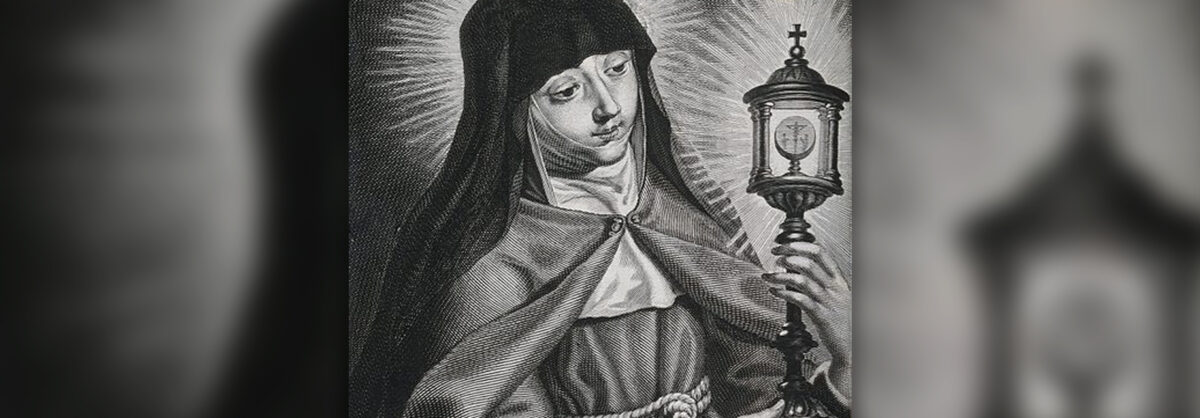

Santa Clara es una de esas santas cuya vida está indisolublemente unida a la de un famoso santo varón: Francisco de Asís. Si queremos entender a Clara y su camino de santidad, primero debemos entender a Francisco, porque él fue el catalizador de su extraordinaria vocación.
Perhaps of all the saints in history, Francis is the least threatening to the contemporary world. Many view him as a harmless, if eccentric, lover of animals and the poor. Of course, if his life and teachings can lead us to love and respect our beautiful earth and all its amazing creatures and be mindful of the needy, that’s all to the good. Pope Francis certainly drew inspiration from his namesake when he warned about climate change and the need to cherish the marginalized and lowly of this world.
However, what is often overlooked today is the root of St. Francis’ love of the poor—his own radical poverty. Francis understood that by freeing himself from worldly attachments and directing all his love to God—the Creator of all that is— he was not rejecting the world but embracing it in all its tragic beauty. Precisely for this reason, he is able to address the sun and moon as his “brother” and “sister” because he, too, is part of creation, wholly dependent on God’s mercy and grace.
Unlike Francis and Clare, most of us spend a lifetime being gradually denuded of what we consider our most treasured possessions—youth, health, our jobs, even, and perhaps most especially, our dreams. The loss of loved ones is certainly the most devastating of these losses. Finally, of course, we must give up our very lives.
But it is the saints who seem to grasp this paradox fully, namely that it is “in giving that we receive,” that only when we completely surrender to the loving heart of Christ can we be authentically free.
It is this radical poverty that spoke to Clare’s eighteen-year-old heart when she first heard Francis preach during a Lenten service in the church of San Giorgio at Assisi in the year 1212.
As the eldest daughter of the Count of Sasso-Rosso and his equally high-born wife, Ortolana (who entered her daughter’s order after her husband’s death), Clare was no doubt dressed to the nines in sumptuous robes and sparkling jewels. She would have been required to dress this way in public so as to give maximum prestige to her father. She and her illustrious family would have been seated (while lesser folk stood) at the front of the church along with the churchmen and the rich merchants.
Imaginemos el contraste entre estos dignos ciudadanos y el desaliñado, demacrado y sucio mendigo que se había convertido en una celebridad en su propia ciudad cuando se despojó de sus ricas vestiduras delante de los padres de la ciudad y renunció a su privilegiado derecho de nacimiento para llevar una vida de santa indigencia.
We don’t know what went on in the minds and hearts of the congregation that day—perhaps some of them privately considered Francis a freak. But we do know what happened to Clare. Her heart burned within her at Francis’s words, igniting a firestorm of love and a deep desire to follow his example.
Clare’s family, of course, were horrified. They had tried to have her betrothed (a binding vow in the Middle Ages) at the age of 12, but when Clare pleaded with them to wait until she was 18, they relented.
There is every indication that Clare’s parents were devout, loving, and desirous of their daughter’s happiness, but they were also completely in step with the customs of the time, which decreed that the daughters of the nobility and the moneyed classes were to be married off in order to increase the wealth and power of their families.
Imagine their consternation—even outrage—when Clare secretly fled her home on the night of Palm Sunday, to the chapel of Porziuncula al pie de la colina sobre la que aún se alza la ciudad de Asís. Allí cambió su costoso vestido por uno de tela sencilla y tomó el velo. Y como símbolo de que había rechazado irrevocablemente un matrimonio mundano por uno con Cristo, Francisco se cortó el pelo.
It was Clare’s loss of her treasured hair (traditionally allowed to grow since birth and considered a woman’s greatest personal asset in the marriage market) that finally convinced her father that she was serious about her vocation and would not change her mind. By cutting off her hair, Clare in effect was saying to her parents: I am not your possession. I belong to God.
Clara fundó una orden de monjas franciscanas, popularmente llamadas Clarisas, y llevó una vida de austeridad, oración y caridad.
Six-hundred years later we would see a comparable surrender to divine providence—and apostolic fervor—in the Catholic conversion of St. Elizabeth Ann Seton, the first native-born American saint and the foundress of the Sisters of Charity of St. Joseph’s.
Born in New York in 1774, Elizabeth, like Clare, encountered pivotal moments where she had to choose between worldly allure and divine calling. Both women hailed from privileged backgrounds yet felt an overwhelming desire to turn away from worldly attachments and surrender themselves entirely to God’s plan for their lives.
After the death of her husband, when she faced financial ruin, Elizabeth could have sought the support of her upper-class Episcopalian family in New York. But Elizabeth was drawn to the Catholic faith by her encounter with the Church—and Christ in the Eucharist—during a trip to Italy with her husband, where he spent his last days. Soon after her return to America she converted and entered the Catholic Church.
Elizabeth’s willingness to forsake her status and endure societal ostracism for her Catholic conversion parallels Clare’s bold rejection of noble expectations. In each case, a clear message was sent—that embracing a life centered on God yields incomparable spiritual wealth that far surpasses temporal riches and comfort.
The contemporary world can admire Clare and Elizabeth for the courage of their convictions; we might even applaud their “lifestyle” choices. But rather like their contemporaries, not many of us would emulate them.
As a wife and mother, living a comfortable middle-class life in contemporary America, I could not give up all my material comforts—car, house, heat, pre-packaged food, hot and cold running water etc.—to lead a life of poverty.
What I can give up, however, is the notion that I am better than others because I have these things; or that I am not spiritually impoverished. In other words, I can strive to become “poor in spirit.”
Clare would say, I suspect, that fine things are not evil in themselves but only in the way we are tempted to use them. In our time, what’s most insidious is the way we let material belongings lull us into the belief that we are masters of our own destinies.
Through their embrace of poverty Elizabeth and Clare expressed the truth that we are not autonomous beings whose purpose in life is to create our own meaning and happiness. This was, after all, the original temptation in the Garden—the seductive proposition that we “can be like gods.”
Isabel y Clara y sus seguidoras rechazaron firmemente esta tentación confiando radicalmente en Dios para que supliera todas sus necesidades. De este modo, rechazaron el instrumentalismo que está en el corazón de nuestra naturaleza caída, negándose a utilizar a los demás como objetos o, de hecho, a convertirse en objetos para que otros los utilicen.
And that, I believe, is why Clare is, amongst other things, the patron saint of television and remote viewing, as odd as this initially seems. We are bombarded day and night, through social media and television, with messages that reduce us to economic statistics—to what we can buy or sell.
Through their radical surrender to Divine Providence, St. Clare of Assisi and St. Elizabeth Ann Seton send the world a different message: that we are all children of God—unique, irreplaceable, precious at all stages of life—and infinitely loved by our Father in heaven.
SUZANNE M. WOLFE creció en Manchester, Inglaterra, y se licenció en Literatura Inglesa en Oxford, donde fue cofundadora de la C.S. Lewis Society. Fue escritora residente en la Seattle Pacific University, donde enseñó literatura y escritura creativa durante casi dos décadas. Wolfe es autora de cuatro novelas: El curso de todos los tesoros (Crooked Lane, 2020), Un asesinato con cualquier nombre (Crooked Lane, 2018), Las confesiones de X (HarperCollins/Nelson, 2016, ganador del premio Christianity Today Book of the Year), y Desvelando (Paraclete Press, 2004; edición revisada, 2018, ganadora del Award of Merit de los premios Christianity Today Book of the Year). Ella y su marido, Greg Wolfe, son coautores de numerosos libros sobre literatura y oración, entre ellos Libros que forjan el carácter: cómo enseñar a su hijo valores morales a través de los cuentos (con William Kirk Kilpatrick, Simon & Schuster, 1994), y Bless This House: Prayers For Children and Families (Jossey-Bass, 2004). Sus ensayos y entradas de blog han aparecido en Convivium y otras publicaciones. Ella y su marido tienen cuatro hijos adultos y tres nietos.
Imagen: Dominio público
Pulse aquí para ver todas las Reflexiones de Seton.