
By: Kevin Shinkle
Long before there was a United States, there was Maryland.
Four centuries ago, Catholic settlers landed along its shores seeking a place where they could practice their faith freely. The churches they built, the missionaries who served them, and the faithful who followed in their footsteps helped shape the story of Catholicism in America.
Today, that story can still be walked.
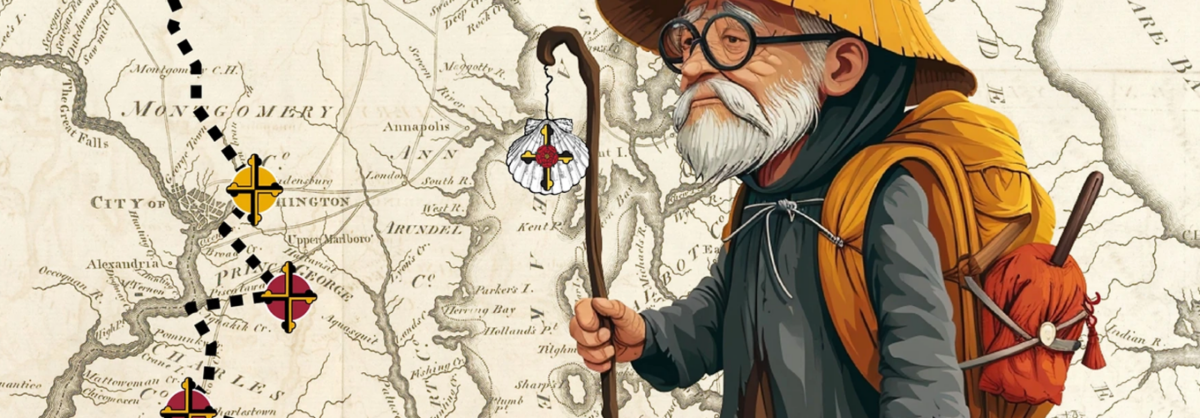
The Camino of Maryland is a 218-mile pilgrimage stretching from Point Lookout, where the Potomac River meets the Chesapeake Bay, to the National Shrine of Saint Elizabeth Ann Seton in Emmitsburg. Along the way, pilgrims pass through some of the most important sites in American Catholic history, from the location of Maryland’s first Mass to historic parishes, shrines, and places connected to generations of faithful Catholics who helped build the Church in the United States.
But the Camino is more than a journey through history. It is a journey toward holiness. For 14 days, pilgrims pray, attend daily Mass, walk together in faith, and follow a path that ultimately leads to the home and tomb of Saint Elizabeth Ann Seton, the first native-born American to be canonized a saint.
As the nation marks the 250th anniversary of its founding, the Camino of Maryland offers a reminder that the Catholic story is deeply woven into the American story. In this conversation, Camino founder Richard McPherson reflects on the inspiration behind the pilgrimage, the spiritual fruits it has produced, and why Saint Elizabeth Ann Seton remains the heart of the journey.
Why a Camino of Maryland? How did you come up with the idea and when?
I had walked the English Way of the Camino in Spain back in 2017. I loved it but I was disappointed that more of the churches weren’t open. But I did think, we need one of these in the United States.
Since 2008, with my schools we have been walking pilgrimages every May in honor of the Virgin Mary. The pilgrimages varied in length from 15 to 23 miles. I figured I just had to string several pilgrimages together. Maryland was the perfect place because it was the only Catholic colony of the original 13 and has such a rich Catholic history. Plus, we had a beautiful shrine to Elizabeth Ann Seton, the first American canonized saint and someone who had lived and died in Maryland. In the summer of 2023, I finally decided to make it happen.
Describe the Camino.
It is a 218-mile walk from Point Lookout (where the Chesapeake Bay and the Potomac River meet) in southern Maryland to Emmitsburg, Maryland where St Elizabeth’s Shrine is located (about one mile from the Pennsylvania line). We stop at 42 churches along the way. We celebrate Mass each day and we pray all four rosaries each day – the joyful, the luminous, the sorrowful, and the glorious.
Most nights we sleep on church grounds either in the parish halls or in tents. Sometimes we sleep at schools and one night we stay at a Boy Scout camp. Some people sleep in motels or Airbnbs or go home at night. We have vans along the way to provide water and snacks and carry equipment and help transport pilgrims.
We stop at many historic spots and important churches:
In Southern Maryland:
St Peter Claver, the first black parish in southern Maryland; St Inigoes, one of the oldest Jesuit churches in southern Maryland with a historic graveyard dating back to 1641; St. Mary’s Chapel, a replica of the original chapel in St. Mary’s City which was built in 1641 but was torn down in 1704.; St Francis Xavier Church, the oldest Catholic parish in continuous operation in the original 13 English colonies (1640); St Clement’s Island, where the first mass in Maryland was celebrated on March 25, 1634; Sacred Heart Bushwood, the oldest parish in the United States named in honor of the Sacred Heart; St Mary Newport, the third oldest parish in Maryland (started by Franciscans) and it also has a Shrine to St John Vianney; St Ignatius at Chapel Point that fights with St Francis Xavier as the oldest continuous active parish in the United States(1640); St Mary Piscataway, where Fr Andrew White baptized 150 Piscataway Indians on July 5,1640.
In Washington, DC:
The Basilica of the National Shrine of the Immaculate Conception; St Pope John Paul II Shrine.
In Northern Maryland:
Old St John’s in Silver Spring, where Fr John Carroll , our first archbishop had a chapel built and where Daniel Carroll, one of two Catholic Signers of the Constitution of the United States, is buried; St Mary’s Church in Rockville where F. Scott Fitzgerald and his family are buried; Shrine of St. Mary’s in Barnesville that is also the official Shrine of Fatima in the Archdiocese of Washington; St Joseph-on-Carrollton-Manor Church was built on land given by Charles Carroll, the only Catholic signer of the Declaration of Independence (and the last to die in 1832);St John the Evangelist Church in Frederick is the oldest parish in the Archdiocese of Baltimore; the National Shrine of the Grotto of Our Lady of Lourdes; and the National Shrine of Saint Elizabeth Ann Seton in Emmitsburg, Maryland.
What is your background?
I helped found The Avalon School (K-12) for boys in 2003 and the Brookewood School (K-12) for girls in 2006. They are recognized by the Archdiocese of Washington as Catholic Schools. I am the president of both schools and the headmaster of Brookewood. I’m married with six grown children (four of them are married) and I have ten grandchildren. I have been in education for 44 years. I am a graduate of Harvard College (’79) and I am an Associate of the Society of Actuaries (1984). I’m originally from Massachusetts but I’ve grown to love Maryland and the DC area.
How big a feat is it to organize something like this?
My wife and I spent almost two weeks in total traveling in southern Maryland and DC during the summer of 2023 to plan the first ten days. I live to the north of Washington, DC so that part of the Camino was much easier to plan. I received input from priests and friends and had great help from Google Maps.
I walked each leg of the Camino at separate times during the year to make sure the roads were safe. It was fun planning with my wife, and we learned a lot about the Catholic history of Maryland. Also, we are lucky to have the support of many teachers and parents of our two schools.
The distance of each leg depended on the location of the churches where we could stay. The legs vary from the shortest, 9 miles, to the longest, 22 miles. It is an average of 15.6 miles a day. Getting a boat and having mass on St. Clement’s Island was a challenge but the people at the St. Clement’s Island Museum proved invaluable.
Where do pilgrims come from?
Last year, we had almost 200 pilgrims participate. They came mostly from Maryland, Virginia and DC. Though we also had pilgrims from Colorado, Massachusetts, New Jersey, and Pennsylvania. This year I expect pilgrims from at least 17 states including, Wyoming, Arizona, Texas, Louisiana, Illinois, Michigan, Indiana, Ohio, Pennsylvania, Massachusetts, New York, Florida, Georgia, North Carolina, Virgina, DC and Maryland. So, this year we expect even more.
What is the hardest part of the Camino of Maryland for you?
The second and third days are long back-to-back days. With the heat and walking on pavement it can be difficult. The 11th day of the Camino is 22 miles and the last stretch of 4.6-miles in Barnesville, Maryland has 8 tortuous hills. We call them the “8 Hills of the Apocalypse!” If you survive that day, you will make it to the end.
What are some highlights from the first two Caminos?
The response of the parishes and the priests has been extremely gratifying. Many thanked us for stopping at their churches and welcomed us with open arms. One response I received, “I cannot tell you how impressed I was at this magnificent gift you have given to the Church of Washington. May it continue for 1000 years or more. Please let me know in the future what I can do to help.”
The bonding among pilgrims has been special. Also, we had two men, one from each Camino, who have entered the seminary immediately after they walked the Camino. Many, many spiritual goods have been received. The news video that EWTN did on our second Camino gave us a lot of press and captured the spirit of the Camino of Maryland beautifully. The support of the St Elizabeth Shrine and its Executive Director, Rob Judge, and his team has been crucial to our success.
Describe your devotion to St Elizabeth Ann Seton.
My niece was born on October 2, 1975, and she was named Elizabeth Ann. Ever since then I’ve had a devotion to Elizabeth Seton. I’ve taken my family to the Shrine on many occasions, especially on her birthday, August 28, and her Feast Day, January 4.
Our students take field trips to the Shrine on regular occasions. It is a beautiful part of Maryland. The scenery along the roads alone is worth the trip to the Shrine.
I’ve also read three biographies of her. That she was a wife, a mother, a teacher, a religious sister, a founder of an order, and a friend to so many makes her accessible to all of us. Her love for the real presence of the eucharist is infectious.
During the Camino we end each Mass and each rosary with “St. Elizabeth Ann Seton. Pray for us.” We carry a relic of hers with us in one of the vans and in our Camino booklet we have a quotation of hers – “Let your chief study be to acquaint yourself with God because there is nothing greater than God, and because it is the only knowledge which can fill the heart with peace and joy, which nothing can disturb.” She is on our minds and in our prayers constantly.
What are your goals for the Camino of Maryland?
I would like it to become a big part of the Catholic Church in Maryland, an event to participate in if you need spiritual goods. Maybe, someday, a rite of passage for high school students before they go off to college or graduates of college before they start their professional lives. I’m hoping more parishes will adopt the Camino and pray with the pilgrims and welcome them when they stop at their churches.
One big vision that I have is that in 2034, the 400th anniversary of the founding of Maryland, it will be the event of the year! Mostly, I want the Camino to bring many people closer to God.
A final thought about the Camino of Maryland.
I think what makes our Camino special is having a saint like Elizabeth Ann Seton and her Shrine to walk to. She is the perfect saint for an American Camino especially this year, the 250th anniversary of America’s founding.
Our greatest wish is for all our pilgrims to make it to heaven. We have the perfect example right in our back yard. St Elizabeth Ann Seton. Pray for us!”
NOTE: The Camino of Maryland Pilgrams arrive at The National Shrine of Saint Elizabeth Ann Seton on Sunday June 21st at about 12 noon. Come welcome them to the shrine and attend the 1:30pm mass with them!