
Detalles
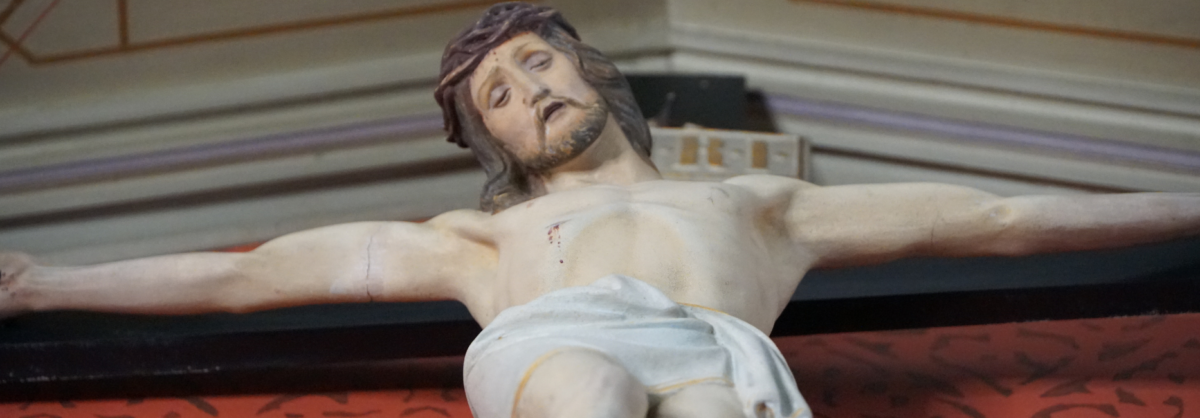
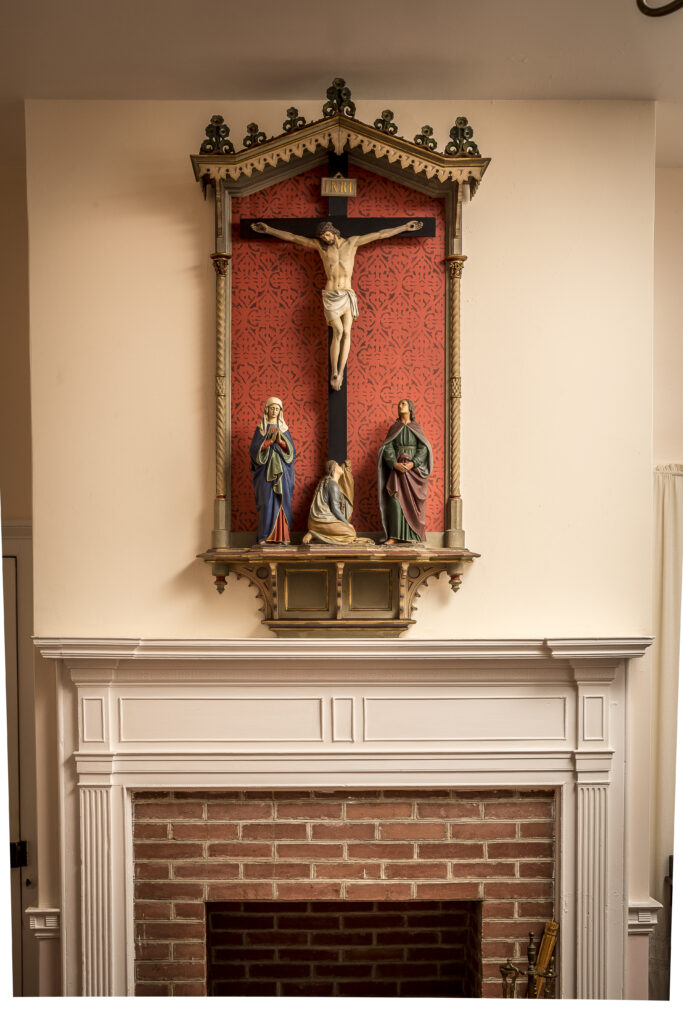
For at least 207 years, a large wood carving featuring the scene from Calvary hung on the wall of the White House that was home to Saint Elizabeth Ann Seton and St. Joseph’s Academy, the Catholic school for girls that she founded. The carving was recently moved to the Servant Gallery of the National Shrine of Saint Elizabeth Ann Seton’s new $4 million museum that will open on Sept. 22.
The piece is quite large measuring 64”H x 35” W. It is constructed of carved and joined wood. The surfaces are prepared with a white gesso and decorated with paint and gilded bead moldings. The carving has been repainted and conserved on several occasions. The original colors were most likely much brighter.
Es posible que la cartela floral sobre el tejadillo y la base se añadieran posteriormente.
Historia
The origins of the carving are unclear, since there is nothing in Mother Seton’s writing that says when she received the piece or was even in the White House during her time. But there is some supporting evidence that it was a gift from the Filicchi family, who played a key role in her conversion to Catholicism.
En la lista de las Hijas de la Caridad figura como regalo de los Filicchi, y lo más probable es que procediera de Gubbio, Italia. Hay pruebas de que los Filicchi no sólo ayudaron económicamente a Isabel, sino que también le regalaron muchos objetos hermosos. Hay, por ejemplo, una factura de venta de $53 por nueve jarrones que fueron enviados a Isabel desde Livorno, muy probablemente por los Filicchi en 1818.
La prueba más valiosa de que la talla de madera colgaba sobre la chimenea de la sala de estar, la habitación en la que murió la madre Seton, es un boceto realizado por el padre Simon Brute en 1816.
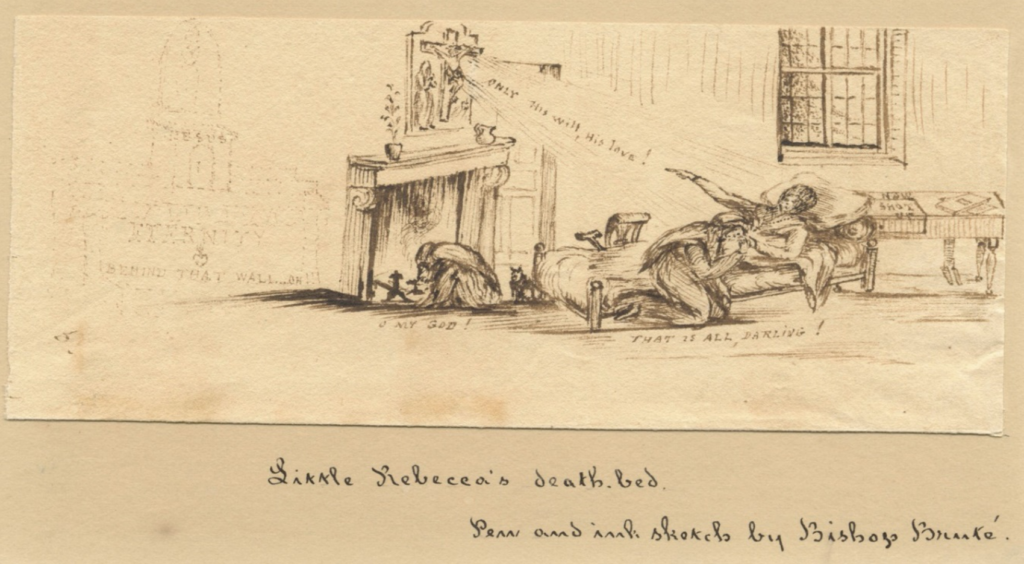
This sketch shows Elizabeth kneeling at the bedside of her daughter, Rebecca. Rebecca died on November 3, 1816, having just reached the age of fourteen. Clearly, the woodcarving is above the fireplace without the extra embellishments. The Daughters currently have over eighty of Brute’s sketches in their collection. These sketches have become important as they speak to the history of what was happening at the school and the Sisterhood that Mother Seton founded during her time.
Los Filicchis
Antonio and Filippo Filicchi were wealthy business associates of Elizabeth’s husband William, and they would take care of her and her children after his death.
“In addition to the orders left with you on my departure from America,” wrote Antonio Filicchi to John Murray and Sons, his New York agents, in 1806, “you are requested to furnish Mrs. Seton with whatever further sum she might at any time call for, to support herself and family.” (Los hermanos Filicchi y Santa Isabel Ana Seton página 105)
Filippo Filicchi is said to have spent several years in the United States, at which time he became familiar to George Washington who later made him the American consul in Leghorn, Italy. Filicchi was appointed consul on 10 December 1794, assumed charge at Leghorn on 20 March 1795, and retired from office in November 1798.
Filippo and his brother, Antonio were merchants and formed the F & A Filicchi Company, which did business with Seton, Maitland & Co., a shipping company started by Elizabeth’s father-in-law, William Seton. The Filicchis were part of the bankruptcy of the Seton company. The two brothers had filed a complaint with the New York City authorities in order to recover the $5,614.73 due to their company due to mismanagement of record books on the part of Seton, Maitland & Company. This equates to $140,686.26 today.
The debt did not stand in the way of friendship. The brothers had known Elizabeth’s husband, William Magee, from an early age. He had gone to Italy to do an internship at the Filicchi firm and made several trips to visit and to do business before his marriage to Elizabeth.
En 1803, cuando Guillermo presentaba síntomas de tuberculosis, llevó a Elizabeth y a su hija, Anna Maria, a Leghorn para que se quedaran con los Filicchis. Los Filicchis las mantuvieron cuando estaban en el lazareto y ayudaron a Isabel tras la muerte de Guillermo. Ellos serían el catalizador que cambiaría su vida y las vidas de muchos en el futuro, ya que la introdujeron en la fe católica.
Para más información sobre el nuevo museo y centro de visitantes del Santuario Nacional de Santa Isabel Ana Seton, visite aquí.