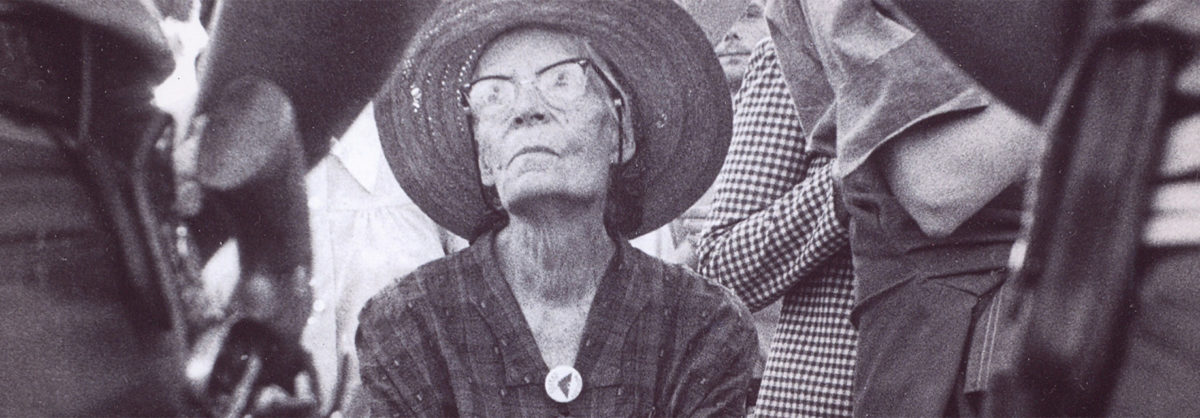

Hace algunos años, Colleen Carroll Campbell escribió un libro titulado Mis hermanas, las santas...sobre cómo varias mujeres santas han caminado a su lado en su vida. Mi versión sería Los santos que me acechan – and high on the list of my saintly sisters following me around New York and beyond would be Servant of God Dorothy Day, who died today in 1980, and St. Elizabeth Ann Seton.
Justo antes de COVID, el libro que preparé, Un año con los místicos: Sabiduría visionaria para la vida cotidiana, included both of these women. They are both known as doers—Dorothy Day for social activism and caring for the poor and forgotten, and Mother Seton for schools and hospitals. But neither one of them could have accomplished what they did without their deep inner lives of prayer, knowing that Jesus was their strength.
Before her conversion, Day spent time at a church close to my heart in Greenwich Village—St. Joseph’s. It’s in the midst of so many of the culture’s confusions—then and now. And yet she was drawn to the peace within because she would come to believe passionately in the presence of Jesus in the Blessed Sacrament. She would go to Him again and again to ask for guidance, to give Him her impossible cases, to beg His forgiveness if she had been too harsh. Like her beloved St. Thérèse of Lisieux, who she wrote a book about, Day’s confidence resided wholly in the Lord.
Dorothy Day is a saint for these times—relatable to women who have been hurt by men; women even who have had abortions and suffer great grief, a sorrow that Day never got over even though she knew that Jesus has endless mercy if we go to Him in loving trust and honest remorse.
En el momento de escribir estas líneas, Dorothy Day aún no ha sido canonizada, aunque la primera fase de su causa está llegando a su fin. Mi cita favorita sobre ella es del arzobispo José Gómez en una conferencia sobre ella hace unos años:
“I don’t know if she’s a saint, but I know she makes me want to be one.”
I feel the same way. So I ask her help constantly, especially when I walk the streets of Manhattan and encounter people who are mentally ill and homeless, people who scare me. With Dorothy Day’s help, I try to see Jesus in them and not walk away. Often, I just don’t want to have to deal with them. Dorothy calls me out when I have that inclination.
I try to love in the mess of life, as she did, even when I’m not entirely sure it is safe or prudent. I’d rather lose my life than fail to love. For that I need Dorothy Day’s and Elizabeth Ann Seton’s help.
Uno de mis favoritos historias sobre la Madre Seton es cómo, antes de su conversión, mientras asistía a los servicios episcopales, se volvía físicamente hacia la cercana iglesia católica del bajo Manhattan. Ella lo conoció antes de profesar la Presencia Real de Jesús en el tabernáculo.
Ambas mujeres son una inspiración para todos nosotros, católicos bautizados, de que Jesús cumple los anhelos de aquellos que aún no conocen la verdad de la Eucaristía.
En 1971, en una carta a un amigo, Karl Meyer, de quien había esperado que tomara el relevo El Trabajador Católico periódico, pero desde entonces se había alejado de la Iglesia, escribió Dorothy Day:
“The sacraments mean much to me. The daily bread we ask for is there. To sit in the presence of the Sun of Justice is healing, though I have to force myself to remain in fatigue and fullness and misery often. But the healing is there too. No matter how corrupt the Church may become, it carries within it the seeds of its own regeneration. To read the lives of the saints has always helped me. We’ve had corrupt popes and bishops, down through the ages, but a St. Francis, a St. Benedict, a St. Vincent dePaul, un Charles de Foucauld seguirá recordándome la primacía de lo espiritual. Peter Maurin (que fundó El Trabajador Católico con Dorothy Day) used to tell us to study history through the lives of the saints.”
Similarly, to her grandchildren, she said: “My greatest joy would be to see all of you practicing the faith. You have to practice it to make it grow, and what a strength and joy it gives, to young and old, in good times and bad times.”
Tanto Dorothy Day como Elizabeth Ann Seton tenían también corazón de madre. Su ternura y compasión por los débiles e indefensos revelan que eran almas gemelas. Considera esto de la Madre Seton:
By the heart we understand the most secret part of the Soul, where joy and sadness, fear, or desire, and whatever we call sentiments or affections is formed—then the love of God in the heart is that sweet attraction which draws us incessantly to him, which desires to enjoy him, delights to be busied with Him, tastes always a new pleasure to Him as the confident of its joys and its pains; it lives under the liveliest impressions of its sovereign Good and intimately enjoys his continual presence.
To love him with the whole heart is all. Also we must include our whole strength by doing all that we can for him, and referring to him whatever we do for others, and with our whole mind by remembering him continually and filling it with him as much as we can. Love is paid by love—and the tenderest Mother has not more delight in holding her little dear beloved in her arms than this child of divine love (the happy soul he dwells in) delights to dwell in the bosom of this best and dearest of Fathers…
As we mark what may someday be Dorothy Day’s feast day, my two holy stalkers show us that radical Christianity consists of a life steeped in prayer and good deeds. This is what makes loving with the Heart of Jesus in the world possible.
Kathryn Jean Lopez es investigadora principal en el Instituto National Review donde dirige el Centro de Religión, Cultura y Sociedad Civil. También es redactora jefe de Revista Nacional y columnista nacional de Andrews McMeel Universal.
Foto: CC BY-NC-ND 2.0
Esta reflexión se publicó anteriormente. Haga clic en aquí para ver todas las Reflexiones Seton.