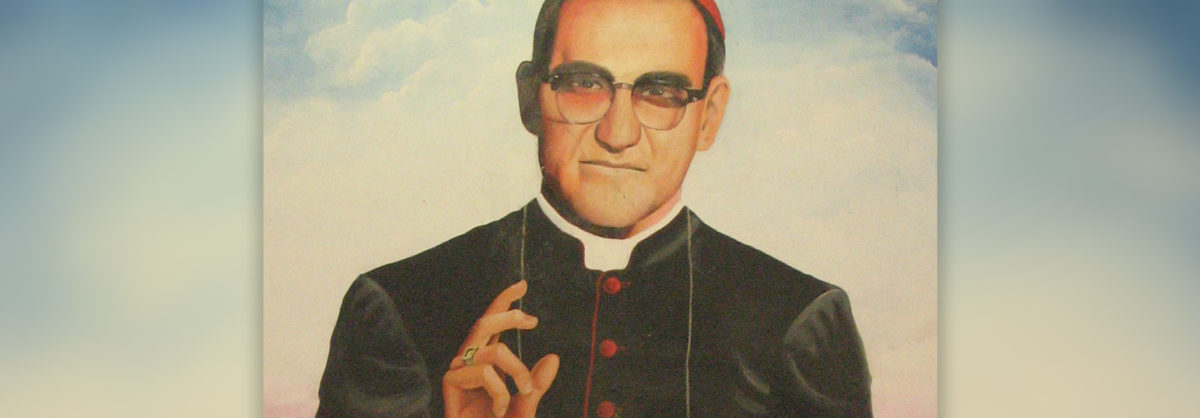

The life of Oscar Romero, like Elizabeth Ann Seton’s, teaches the need to do the works of mercy, including the very difficult ones.
“The corporal and spiritual works of mercy should become ever more the style of our life,” as Pope Francis put it — a daily duty.
Para la mayoría de nosotros, las obras de misericordia significan colectas de alimentos y ropa. Para Romero y la Madre Seton, significó tolerar terribles sufrimientos y llevar a cabo difíciles curaciones. Considera cómo sus vidas reflejan algunas de las obras de misericordia más duras.
Instruir a los ignorantes.
Oscar Romero was born in El Salvador in 1917, where “instructing the ignorant” was tough. The city offered public education for Grades 1 through 3 to give a rudimentary understanding of math and reading. But Romero’s parents wanted something more for him, so they arranged for a private tutor until age 13.
Nadie se sorprendió cuando el piadoso niño dijo que quería ser sacerdote católico e ingresó en un seminario menor. Su educación continuó con estudios en la Universidad Gregoriana de Roma. Fue ordenado sacerdote en 1942 y devolvió el favor de instruir a los ignorantes convirtiéndose en redactor del periódico de la archidiócesis, donde adquirió fama de fidelidad al Magisterio de la Iglesia.
The impoverished childhood of the Salvadoran son of Santos and Guadalupe could not be more different than Elizabeth Ann Bayley’s affluent early years in 18th-century New York.
Elizabeth creció comprometida con la fe episcopaliana de su familia, y se casó y empezó a criar a sus cinco hijos en ella.
A diferencia de Óscar Romero, Isabel se hizo católica más tarde, después de llevar a su marido enfermo a Italia con la esperanza de que se curara. Allí murió, y poco después la familia Filicchi la introdujo en la Iglesia católica. La familia Filicchi siguió en contacto con ella cuando regresó a casa, aprendió la fe y comenzó a instruir a sus hijos.
“You would have been pleased to hear their questions about St. Michael and how eagerly they listened to the history of the good offices done to us by the Blessed angels,” the still-Protestant Elizabeth wrote in 1804. After each lesson, she said, “I bless them each with the Sign of the Cross and I look up to God with a humble hope that he will not forsake us.”
Aconsejar a los dubitativos.
Romero was martyred at Mass in 1980 by unknown assailants allied with El Salvador’s ruling regime, at a time when Marxist elements in El Salvador were active, and when controversial forms of “liberation theology” were stirring in the Catholic Church. As a result, some Catholics feel an unease towards Romero, as if he was somehow a spokesman for this theology.
Chris Bain, líder de una organización caritativa católica británica, explicó a la Agencia Católica de Noticias (CNA) cómo sucedió esto.
El Salvador was “run by a repressive, self-styled right-wing regime whose brutality was justified as necessary to stop the country from becoming communist, an approach supported by the U.S. government at the time,” he said.
Sin abrazar la teología de la liberación, Romero habló contra las atrocidades del régimen gobernante y aconsejó a otros que hicieran lo mismo. Esta es la razón por la que fue asesinado.
After his martyrdom the political Left “made him in their image without understanding him fully, and the Right colluded.”
What people don’t understand, said the postulator for Romero’s cause, Archbishop Vincenzo Paglia, was that Romero was not a “reformer, let alone a politician, as some have wanted to see him, exploiting his name.” Instead, he was a “man of God, a man of prayer, a man of obedience and love for people.”
Soportar las injusticias con paciencia.
“Romero’s witness of martyrdom, starting from Latin America, through Pope Francis, can help the whole of America, the whole of Europe,” Archbishop Paglia told the Catholic News Agency.
El Salvador’s government had tolerated, or facilitated, the murder of 30 priests in his archdiocese, and death squads had killed many catechists and abducted many lay faithful. In the face of these trials, Archbishop Romero said he could find “rest, peace and strength” in Christ, and felt that the martyrs would “feel His closeness when offering their last breath.”
On March 24, 1980, Oscar Romero gave what was to be his last homily in the Hospital of Divine Providence. “We know that every effort to improve society, especially when society is so full of injustice and sin, is an effort that God blesses; that God wants; that God demands of us,” he said.
Mientras Romero levantaba el cáliz en la consagración de la Eucaristía, un asesino a sueldo entró en la capilla y lo mató a tiros.
St. John Paul II noted that Romero died as other saints did who were killed at the altar—St. Stanislaus of Krakow and St. Thomas Becket of Canterbury—saying, “They killed him right at the most sacred moment, during the highest and most divine act.”
A strong connection between the Eucharist and martyrdom of a different sort was a daily part of St. Elizabeth Ann Seton’s life.
Tras ingresar en la Iglesia católica, la Madre Seton se hizo religiosa profesa y fundó una congregación que atendía a niños y pobres. Trabajaba desde una oficina situada de modo que podía ver el tabernáculo a través de la puerta de la capilla durante todo el día.
Looking to the tabernacle in the midst of her duties, she would at times experience what she described as “a daily martyrdom. I love and live, and love and live in a state of separation indescribable.” Her martyrdom was a profound sense of absence: “In meditation, prayer, communion, I find no soul; in the beings around me, dearly as I love them, I find no soul; in that tabernacle I know he is, but I see not, feel not.”
Amonestar a los pecadores.
Monseñor Óscar Romero fue asesinado in odium fidei, out of hatred for the faith, and that included Romero’s adherence to Christ’s message of service to the poor. His message was “like a slap in the face to a contemporary society folded in on itself, each individual interested in his own well-being,” Archbishop Paglia told CNA.
“It is inconceivable,” said Romero in a September 9, 1979 homily, “that someone is called ‘Christian’ and does not give preference to the poor as Christ did. This is not Christianity! … Let’s say to everyone: we must take the cause of the poor seriously, as if it were our own cause, or even more, for it is indeed the very cause of Jesus Christ.”
La vida de un santo implica inevitablemente la desagradable tarea de amonestar a los pecadores. En su Obras completas, Así lo atestiguan varias cartas que la Madre Seton escribió a los padres de ciertos alumnos.
She told one set of parents that their child had a “disposition to self-will which made herself and us unhappy.” In reference to another child, she spoke of the “true danger” of “pushing her too far too fast,” forcing “an exterior look without the interior spirit.”
Para consolar a los afligidos.
Like any loving mother, Elizabeth Seton believed that admonishment of a child—if done with kindness and sensitivity—is meant for the sake of a greater comfort. And that is also true of a bishop, a spiritual father and representative of Mother Church.
At the beatification of St. Oscar Romero, Cardinal Angelo Amato, the prefect of the Congregation for the Causes of Saints, said that “the figure of Romero is still alive and giving comfort to the marginalized of the earth.”
In a similar way, the legacy of St. Elizabeth Ann Seton’s service to the poor has continued to bless untold numbers of people over the past two centuries.
TOM HOOPES, autor más reciente de El Rosario de San Juan Pablo II, es escritor residente en el Benedictine College de Kansas, donde imparte clases. Es anfitrión de La extraordinaria Story podcast sobre la vida de Cristo. Su libro Lo que dijo realmente el Papa Francisco ya está disponible en Audible. Antiguo reportero en la zona de Washington, D.C., fue secretario de prensa del Presidente del Comité de Medios y Arbitrios de la Cámara de Representantes de los Estados Unidos y pasó 10 años como editor del periódico National Catholic Register y de la revista Faith & Family. Su trabajo aparece con frecuencia en el Register, Aleteia y Catholic Digest. Vive en Atchison, Kansas, con su esposa, April, y tiene nueve hijos.
Imagen: Creative Commons 3.0
Esta reflexión se publicó anteriormente. Pulse aquí para ver todas las Reflexiones Seton.