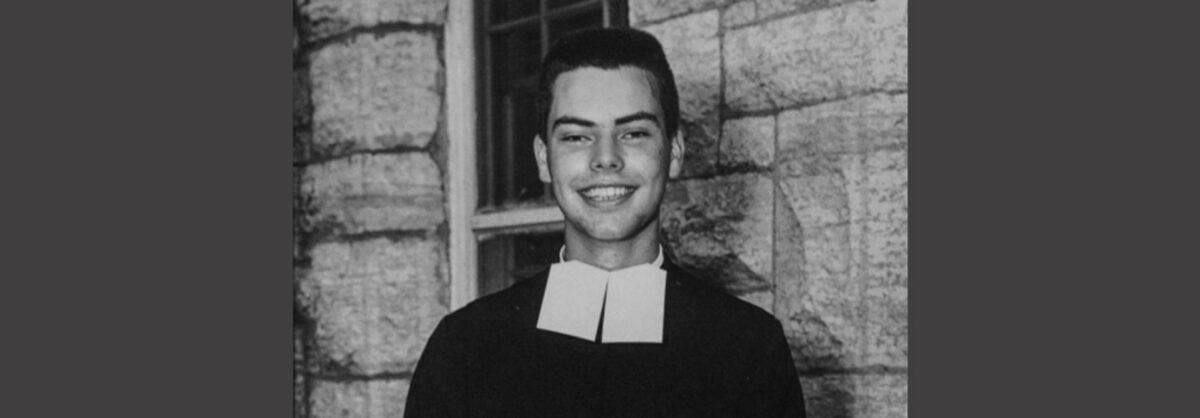

“Ordinary people can and do extraordinary things,” Louise (Miller) Brilowski told her diocesan newspaper.
She should know. She grew up on a farm in Wisconsin with Blessed James Miller, who became a martyr of the Catholic Church and citizen of heaven in 1982.
“He started out as an ordinary little farm boy from Ellis, and he achieved extraordinary things. Not only in life but also in death. To think, my brother is able to sit at the right hand of God and take petitions from those of us on earth.”
That is exactly where he is — with other extraordinary “ordinary” people such as St. Elizabeth Ann Seton.
James Miller was an underweight baby who grew up to be a very tall man.
Despite being four pounds at birth and 6-foot-2 as a Christian Brother, Jim Miller was very much an “average” Midwestern Catholic. Nothing about him surprised anyone very much — except perhaps his laugh, which was sudden and enthusiastic.
The oldest of five children, James Miller had an ordinary vocation story. He went to a Catholic high school where he met the De La Salle Brothers and found his religious vocation, entering a pre-vocation program as a sophomore in 1959. After taking a religious name as a novice in August 1962 (“Leo William”), he would return to using his baptismal name, James — or Jim, as he was called at home, or Santiago, as he was called on mission.
The path he took as a religious was also typical of his congregation. As a young De La Salle Brother he taught Spanish and English at a St. Paul, Minn., high school before being sent overseas to Nicaragua upon taking his final vows in 1969. There he was an effective missionary, teaching in schools, and then helping expand the education apostolate in the country.
When he returned to the States, he taught high school again in St. Paul, where he earned the nickname “Brother Fix-it” because he was handy at solving maintenance problems. His iconography sometimes includes a wrench, a tool he was often seen holding.
He missed his missionary work, and kept asking to be sent back to Latin America. He got his wish in 1981 when he was transferred to Guatemala where he served the indigenous population, teaching job skills and human virtues.
His life, in fact, was ordinary until it ended in an extraordinary way on Feb. 13, 1982.
That is when Brother Fix-it was on a ladder repairing a wall at De La Salle Indian School. He sent a student inside to get a tool for him, but other children witnessed three masked men in a speeding car arrive on the scene.
They shot Miller and he fell from the ladder, dead. He was killed during the same string of assassinations as Blessed Stanley Rother of Oklahoma.
“The murder of Brother James Miller brings to 15 the number of priests and religious workers who have been kidnapped or murdered in Guatemala in the last 18 months,” Brother James’s congregation reported at the time.
The motive for the murder may have been Miller’s protection of native boys who were being conscripted into Guatemala’s army illegally as students. “The murder of Brother James was probably meant as a warning to the Brothers to cease interfering in government affairs,” Paul Kotz, Ph.D., a Saint Mary’s University of Minnesota professor, told a reporter in 2017.
Pope Francis would later say Miller “paid with his life for his service to the Guatemalan people and the Church.” His death was recognized as a martyrdom by the Church and Pope Francis beatified him on Dec. 7, 2019.
His martyrdom spotlights the greatness of ordinary Catholic virtues.
When Professor Kotz was in high school, he had known Brother Jim Miller.
“He was working on a light fixture near my locker,” Kotz said. “He asked me to hand him some tools. He started to call me Pablo. He told me it meant ‘friend.’ … He struck me as a man who understood the gravity of major issues in the world, but at the same time preferred to live a humble life of service.”
That humble dedication to service is what the faith asks of every Catholic, but cases like Miller’s show the hidden power of these “ordinary” virtues. As Miller wrote in a letter home in 1981:
“Aware of the many difficulties and risks we face in the future, we continue to work with faith and hope and trust in God’s providence … I am personally wary of violence, but I continue to feel a strong commitment to the suffering poor of Central America.”
Brother Jim’s mother, Lorraine Miller, said, “He knew the conditions there and that there was a possibility that this would happen. In spite of it, that was his choosing and he loved his work.”
On the morning of his assassination, Miller showed his love for his students, reporting to his congregation that he planned to take them on a Valentine’s Day picnic the following day, a Sunday.
They loved him back. His little sister Louise told her diocesan newspaper that she was mobbed like a celebrity by well-wishers when she visited her brother’s confreres and former students 10 years after his death. “In many ways, I think he guided me through the crowds and helped me do what I had to do,” she said. “Knowing Jim, he would have thought, ‘Wow, this is a whole lot of fuss for me?’”
Brother Frank Carr, FSC, a classmate, said “For those of us who knew him he was ordinary like us. But if you die for something you believe in, that’s altogether different.”
Like Miller, Mother Seton was an apostle of the “plain way.”
Elizabeth Ann Seton was also an extraordinary “ordinary” person. If Jim Miller was an average Midwestern farm boy who just happened to build schools for Guatemalan indigenous students until he was martyred, then Elizabeth was an early American mother and widow who happened to found a religious congregation and, with it, the beginnings of the American system of Catholic education.
Her mission was the same as Jim Miller’s. She wrote of “the promising and amiable perspective of establishing a house of plain and useful education … with the view of providing nurses for the sick and poor, an abode of innocence and refuge.”
Her spirituality was deeply influenced by St. Vincent de Paul, whose life she translated, writing, “he would say, ‘simplicity of heart makes us go straight to God and say the truth — without pretension disguise or human respect’ … for nothing draws on us the favor of God and esteem of man so certainly as integrity and simplicity in our words and actions.”
We pray for the simplicity and integrity of Saint Elizabeth Ann Seton and Blessed James Miller, so that we might one day live with them, in the company of the ordinary Christians in glory, forever.
TOM HOOPES, author most recently of The Rosary of Saint John Paul II, is writer in residence at Benedictine College in Kansas, where he teaches. He hosts The Extraordinary Story podcast about the life of Christ. His book What Pope Francis Really Said is now available on Audible. A former reporter in the Washington, D.C., area, he served as press secretary for the U.S. House Ways & Means Committee Chairman and spent 10 years as editor of the National Catholic Register newspaper and Faith & Family magazine. His work frequently appears in the Register, Aleteia, and Catholic Digest. He lives in Atchison, Kansas, with his wife, April, and has nine children.
Image: Blessed James Miller. Public Domain.