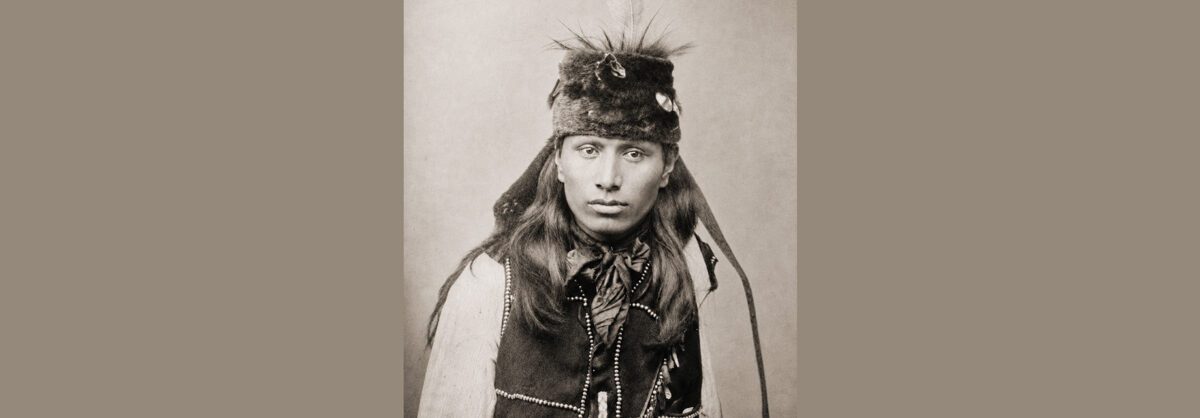

Two American-born Catholic figures lived in radically different cultures — but ultimately found a common home in the Catholic Church.
One was the Native American medicine man turned Catholic Catechist Nicholas Black Elk, who was born near the Little Powder River in Wyoming. The other was Elizabeth Ann Seton, the educator and foundress who was born near Wall Street in New York City in 1774.
Both had to leave the cultural homes that nurtured them, only to make a new beginning in the Catholic Church — which canonized Mother Seton and declared Black Elk a Servant of God.
Black Elk’s life is not what more than a million readers think it is.
Black Elk was born in 1866 into the Big Road’s band of Lakota Indians and he grew up to hunt, fight and travel with the Great Plains Indians.
His story was made famous by the book Black Elk Speaks, by John Neihardt, a poet scholar, who interviewed Black Elk in South Dakota in 1930, when Nicholas Black Elk was in his 60s. The book was billed as the life story of Black Elk. Only it wasn’t. The book was a poetic adaptation of what Black Elk had to say — and stopped his story in 1890, excising what Black Elk saw as the ultimate purpose of his life, his conversion and passion for spreading the Catholic faith.
Even the Lakota rituals described in the book were changed to be more appealing to the 1930s American public. The embellishment was unnecessary. The actual details of Black Elk’s story are gripping enough, tracing the life of a man who was present at the Battle of Little Bighorn and the Massacre at Wounded Knee, a man who met Crazy Horse, Sitting Bull, Queen Victoria and Buffalo Bill.
Black Elk’s life showed both the wild divergence and ultimate compatibility of Lakota and Catholic rituals.
The Lakota people placed great importance on dreams, and central to Black Elk’s story was a powerful vision he had in his childhood. The vision has resonances with the Book of Revelation. Both involve supernatural creatures, mystical horses, and preternatural beings bearing messages from the four directions of the earth.
When Black Elk told his elders about the vision around 1881, they were impressed — and invited him to act it out, a necessary step in unlocking the vision’s power for his community, much as the Passover and Eucharistic liturgies open channels of grace.
A sacred hoop figured strongly in Black Elk’s vision — a symbol of the Lakota nation. He sees a holy tree growing at its center, but when the hoop is broken, horrific consequences follow. Black Elk understood that his vocation was to restore the circle.
He failed to do so, and more than a decade later he had a second, complementary vision. The Ghost Dance movement was a Native American religious revival that was brutally suppressed by the U.S. military at Wounded Knee.
During a dance in 1890, Black Elk said he was welcomed by a man “with holes in the palms of his hands.” As he described it:
“I saw the holy tree full of leaves and blooming. … Against the tree was a man standing with arms held wide in front of him. I looked hard at him and could not tell what people he came from. He was not wasichu [white] and he was not Indian. His hair was long and hanging loose … his body began to change and became very beautiful with all colors of light … He spoke like singing: ‘My life is such that all earthly beings and growing things belong to me. Your Father the Great Spirit has said this. And you too must say this.’”
Answering this supernatural call occupied the rest of Black Elk’s life.
In 1892, he married a Catholic Native American named Katherine War Bonnet, with whom he had three children before her death in 1903, each of whom was baptized. Black Elk himself was baptized on December 6, 1904, and took the name of the saint of the day, Nicholas. He later married Anna Brings White, with whom he had three more children before her death in 1941.
Jesuits appointed Black Elk to be a Catechist — a designation that meant far more than teaching religion. On the reservations, where no priest was available, Catechists baptized babies, organized religious events, and led prayer services. Though some have suggested that Nicholas Black Elk’s heart stayed with his original Lakota beliefs, the evidence says otherwise.
He eventually gave up the practice of his medicine man services, afraid they contradicted his new faith. He participated in native dances at South Dakota powwows, but his main work was teaching Jesus’s life through a new hoop — the rosary — and the “Two Roads” map that traced Salvation History.
For Black Elk, conversion meant embracing the hard work of forgiveness.
Again and again, Nicholas Black Elk encountered brutality and cruelty, but he learned to distinguish the sins of individuals from the peoples to which they belonged.
He remained open to new cultures despite all he suffered, and after traveling through Europe with Buffalo Bill Cody’s Wild West show, he wrote, “I traveled to one city after another, and there were many customs around God’s will.”
He had also seen the best and worst of Native American culture, and he learned to forgive violence committed by rival tribes, including the Crow, whom he had grown up denigrating as horse thieves.
St. Elizabeth Ann Seton also learned to open her heart to other cultures.
When her Spiritual Director Father Simon Bruté considered becoming a missionary to native populations, Elizabeth applied the stereotypical characterization of Native Americans to the whole human race, writing, “Oh my! To see man a wild savage, a polished savage, man in any state; what a savage! — unless he be in Christ.”
In advice she wrote to her son, William, in 1815, she counseled him to be open to people of all cultures, just as she herself had been when she visited Italy and embraced the Catholic faith.
“I beg you so much not to give way to national prejudices, but to allow for many customs and manners you will see,” she wrote. “Why should not others have their peculiarities as well as we have ours?” she asked, and said he must never “jest or laugh at others. It would be a great Mark of ignorance and ill manners to do so.”
From St. Paul in the Greek Areopagus to Matthew Ricci in China, the Church has adapted itself to every culture on earth.
As the Catholic Catechism teaches, “the Church … travels the same journey as all humanity” and its missionary work “must involve a process of inculturation if the Gospel is to take flesh in each people’s culture” (CCC 854).
The Diocese of Rapid City, which opened the cause of his canonization, says Black Elk is a beautiful example of this. Its website provides Black Elk’s Catholic writings, including the English translation of his “Last Word.”
“I now know that the prayer of the Catholic Church is better than the Sun-dance or the Ghost-dance. Old Indians danced that kind for their own glory. They cut themselves so that the blood flowed. But Christ was nailed to the Cross for sin and he took away our sins … Now I hate sin. I want to be straight as the black-gown church teaches us to be straight to save my soul for heaven. This I want to do. I cheerfully shake hands with you all.”
Cultures rise and fall, but the Church remains.
TOM HOOPES, author most recently of The Rosary of Saint John Paul II, is writer in residence at Benedictine College in Kansas, where he teaches. He hosts The Extraordinary Story podcast about the life of Christ. His book What Pope Francis Really Said is now available on Audible. A former reporter in the Washington, D.C., area, he served as press secretary for the U.S. House Ways & Means Committee Chairman and spent 10 years as editor of the National Catholic Register newspaper and Faith & Family magazine. His work frequently appears in the Register, Aleteia, and Catholic Digest. He lives in Atchison, Kansas, with his wife, April, and has nine children.
To view all of our Seton Reflections, click Click here to view all of our Seton Reflections.