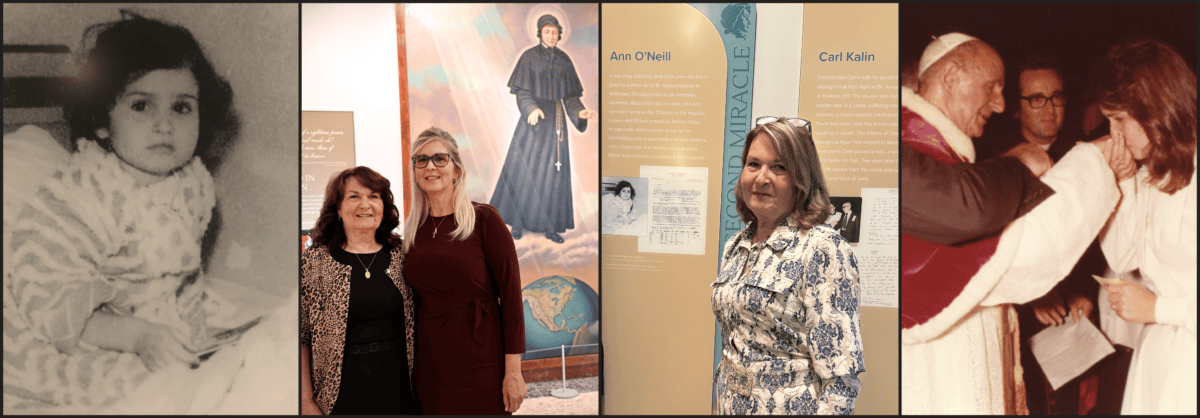

Ann O’Neill spent more than seventy years answering questions about a miracle.
Yet, if you talked with her for any length of time, you discovered she wasn’t really interested in talking about miracles.
She wanted to talk about her mother’s faith.
She wanted to talk about Mother Seton.
Mostly, she wanted to talk about Jesus.
That may be the clearest evidence of why God chose her life to become part of one of the most important stories in American Catholic history.
As a four-year-old girl, Ann was brought to the tomb of Elizabeth Ann Seton in Emmitsburg, Maryland, after doctors had exhausted every medical option for the leukemia that seemed certain to claim her life. Days later, her blood counts returned to normal. The Church ultimately recognized her healing as one of the miracles attributed to Mother Seton’s intercession, an integral part in her canonization in 1975 as the first native-born American saint.
Ann died recently at the age of 78, and that remarkable event forever linked her life with that of Saint Elizabeth Ann Seton. But anyone who knew Ann quickly discovered that she never believed the story was really about her.
When she spoke about the miracle, she typically referred to her healing as “my mother’s miracle,” insisting that it was her mother’s unwavering trust in God that carried their family through those darkest days.
That humility became one of Ann’s greatest gifts to the Church. She spent the rest of her life not reliving the miracle but living its message.
She raised a family. She remained deeply devoted to Mother Seton. She attended Mass faithfully, welcomed opportunities to share her story with pilgrims and visitors, and filled her home with reminders of the saints who had become lifelong companions on her journey of faith. Through seasons of profound joy and heartbreaking loss, including the death of her youngest son, Ann never lost her confidence that Christ remained close.
In this interview with the Catholic Review last year, Ann offered perhaps the simplest and most beautiful description of the communion of saints: “The saints are like our friends. Mother Seton was my mother’s friend. She’s my friend. And because we’re Catholic, we have a lot of friends in heaven.”
Those words reveal something important not only about Ann, but about the Catholic faith itself.
The Church’s careful process for recognizing saints ordinarily includes miracles because they are understood as signs that these holy men and women continue to live in Christ and intercede for us. The saints are not distant figures frozen in history. They are members of God’s family who continue to accompany the Church through their prayers.
Ann understood that reality not simply as a teaching of the Church, but as a way of living.
Her life became one of the most visible reminders that Mother Seton’s story did not end with her death in 1821. Countless people have come to know Saint Elizabeth Ann Seton as a friend in heaven because the Church was able to recognize officially what Ann’s healing helped reveal.
That is an extraordinary legacy.
Yet, Ann herself would probably tell us that her legacy was never the miracle. Reflecting on her own healing, she remarked with characteristic humility, “We all have miracles all the time. Mine just happened to be the one they used for the Church.”
In that simple observation is a profound truth.
Ann understood that miracles are never ends in themselves. They invite us to believe more deeply, to trust more fully and to recognize God’s loving presence in our lives. Like every authentic miracle, hers pointed beyond itself.
It pointed to Christ.
My fondest memory of Ann came during the 40th anniversary celebration of Mother Seton’s canonizations when she took the gifts up at Mass with her mom, some of her children and some of her grandchildren. Seeing her with her family, you realized that without that miracle and without her mother’s faith, those children and grandchildren wouldn’t be there. It drove home the point that that we are all reliant on God’s grace for our lives. Ann was a concrete and vivid reminder of that reality.
We are now deeply honored that Ann is being laid to rest here at the National Shrine of Saint Elizabeth Ann Seton, near the Basilica where Mother Seton, herself, is entombed. Pilgrims will continue to come to Emmitsburg seeking the prayers of America’s first native-born saint. Many may also pause to remember the woman whose life became an indispensable part of that sacred story.
Ann, of course, would likely be the first to remind us once again that the story was never really about her.
It was about the God she trusted.
The Savior she loved.
And the saint she called her friend.
Rob Judge is the executive director of the National Shrine of Saint Elizabeth Ann Seton in Emmitsburg, Maryland.
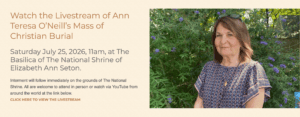
Funeral Mass for Ann O’Neill
The National Shrine of Saint Elizabeth Ann Seton will host the funeral of Ann O’Neill on Saturday, July 25, 2026.
- Funeral Mass: 11:00 AM
- Burial to follow
Archbishop William E. Lori will serve as the principal celebrant.
Watch the Funeral Mass Livestream here.
Learn more about Ann’s story: