
History is often told in battles and declarations. But God also works through the ordinary.
As the United States prepares to mark 250 years of independence, the National Shrine of Saint Elizabeth Ann Seton is turning its attention to a quieter scene: a family gathered around a tea table in colonial New York. In that setting — shaped by British rule, social custom, and rising unrest — the young Elizabeth Ann Bayley first learned the rhythms of a world she would one day leave behind in answering a very different call.
Tea Culture and the American Revolution, an exclusive America250 Seton Shrine program offered February 21 and March 7, invites visitors to reflect on the role tea played in everyday life during Elizabeth Ann Seton’s lifetime and in the years surrounding the American Revolution. Led by Scott Keefer, Provincial Archivist for the Daughters of Charity Province of St. Louise, the program traces tea’s journey from the mountains of China to colonial New York and into American homes, exploring how this everyday ritual shaped family life, social customs, and culture in the late 18th century. During the sessions, visitors will have the opportunity to sample tea of the same variety found in the Bayley family’s tea caddy and commonly consumed in colonial America, bringing the Revolutionary era to life not only through story, but through taste.
To offer additional context for the upcoming sessions, we sat down with Keefer for a Q&A previewing the program and exploring why something as ordinary as a cup of tea can deepen our understanding of the past.
Why do a talk on tea at the Seton Shrine?
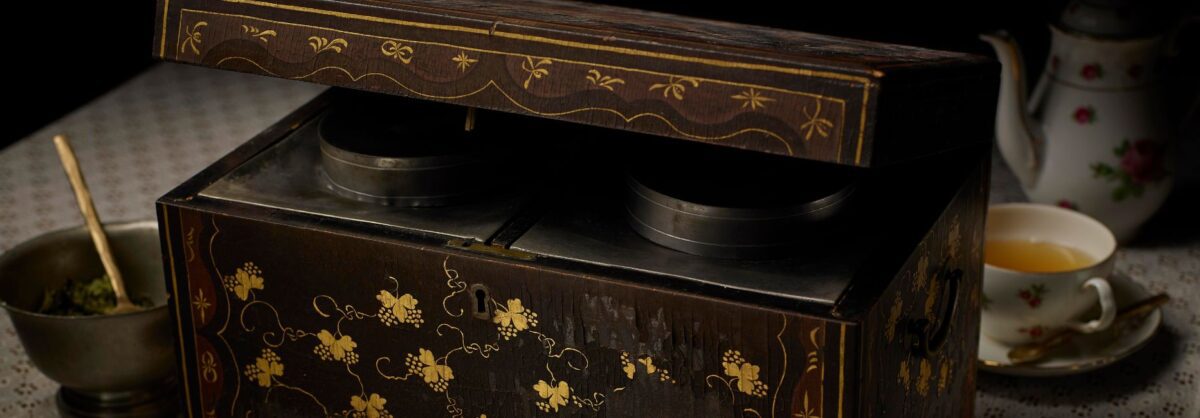
This program began as something of a personal project for me. A few years ago, the Shrine received a tea caddy that belonged to Elizabeth Ann Seton’s father, Dr. Richard Bayley, and one of its tin canisters still contained tea leaves from the period. That discovery, combined with tea’s strong association with the colonial era and the American Revolution, made this an especially fitting moment to explore the topic as the nation approaches its 250th anniversary.
For many people, when they think about tea and the beginnings of America, the Boston Tea Party comes to mind. Is there a connection between that moment and the kind of tea being used in American homes at the time?
There is a direct connection. The Boston Tea Party was a highly deliberate act, both politically and symbolically. More than 80 percent of the tea thrown into Boston Harbor was Bohea tea, the most common tea consumed in American homes at the time and one that could only be legally imported through the British East India Company. That made it a powerful symbol of British control and colonial resistance.
When we examined the tea leaves found in the Bayley family’s tea caddy, a specialist identified them as Bohea as well. That connection helps bridge what is often remembered as a dramatic political moment with the realities of daily life. This was the tea people were drinking in their homes, including in households like Elizabeth Ann Seton’s.
Tea continued to be consumed even after the Boston Tea Party, though attitudes toward it began to shift. Some colonists made efforts to avoid it altogether or turned instead to coffee, a transition that helped shape America’s emerging coffee culture. John Adams captured that tension in a letter when he wondered whether it was acceptable to drink tea if it had been “honestly smuggled.” His reflection reminds us that tea remained familiar and valued, even as it became politically charged.
When we think about daily life in late-18th-century America, why is tea such a revealing lens for understanding family routines and social customs?
Tea offers a revealing window into daily life in late-18th-century America because it sat at the intersection of home, social custom, and an emerging national identity. This period marked a transition – from colonies to a new nation, and increasingly from tea to coffee – and those shifts were reflected in how people gathered and interacted.
At the time, society largely operated within separate spheres. Men’s public life unfolded in taverns, inns, and coffeehouses, while women’s influence was centered in the home. Tea was closely tied to that domestic space. It was served in the parlor, brewed and shared in front of guests, and often displayed through decorative tea caddies that signaled hospitality and status. The ritual of tea service created space for conversation and connection – what we might think of today as a form of social or even political exchange. While the physical labor of preparation was often carried out by servants or enslaved individuals, this structure allowed hosts, especially women, to remain engaged with their guests without interruption.
As the Shrine marks America’s 250th anniversary, how does tea culture – both historically and personally – shape the way you understand Elizabeth Ann Seton’s life and the world she was born into?
Elizabeth Ann Seton was born into a world shaped by British control. During her early childhood, New York and its surrounding areas were occupied by British forces, and her family lived in communities that were largely loyalist in orientation. Her father, Dr. Richard Bayley, was deeply embedded in that world, serving as a surgeon for Admiral Howe’s fleet during the occupation. Despite this, he became respected as a public servant as health officer in New York City by many of the New York-based Founding Fathers. Tea was closely tied to that world, both culturally and economically, and it remained part of the Bayley household well into Elizabeth’s adulthood. Even after her family’s financial collapse in 1803, household inventories show that tea wares were still present, underscoring how deeply ingrained those customs were.
Over time, however, we can trace a broader transition that mirrors both Elizabeth Seton’s life and the nation’s own evolution. As she moved from occupied New York to Emmitsburg and began establishing a distinctly American religious community, everyday habits shifted. Records from the early Sisters of Charity show a clear movement away from tea and toward coffee – often carrot coffee – reflecting changes in economy, identity, and daily practice. Tea, once a familiar marker of social life closely associated with British culture, became more occasional and practical.
Preparing for this program has made me think differently about how something as simple as sitting down with a cup of tea can reflect those larger changes. In Mother Seton’s story, tea traces a movement from comfort to sacrifice, from private life to public service, and from a colonial world shaped by British influence to a new American expression rooted in service, education, and community. Seen through that lens, tea culture helps us understand how personal lives and national history unfolded together, even in the most ordinary moments.
Why do you think something as ordinary as tea can open the door to deeper conversations about history, identity, and daily life in early America?
Tea works as an entry point because it is both familiar and meaningful. Most people already have some relationship with tea, whether through comfort, tradition, or routine. That familiarity helps bridge past and present, reminding us that everyday life in the late 18th century was shaped by similar habits and rhythms.
At the same time, tea points to the interconnected nature of the world Elizabeth Ann Seton was born into. While it was consumed in private homes, it was also a global product. The tea found in the Bayley family’s caddy originated in China, moved through international trade networks, crossed oceans, and passed through London before reaching American households. Looking at tea in this way allows us to see how global commerce, political tension, and daily routine coexisted in Revolutionary-era America, shaping both identity and lived experience.
What do you hope attendees take away from this special event, both in terms of historical understanding and personal reflection?
I hope attendees leave with a deeper appreciation for how complex and interconnected the world already was in Elizabeth Ann Seton’s time. While the systems and challenges were different from those we face today, people in the late 18th century were also living within a global network shaped by trade, politics, and cultural exchange.
I also hope visitors come away with a renewed sense of how history can be understood through small, familiar things. We often focus on well-known figures and major events, and those certainly matter. But history is also carried through everyday objects, household records, paintings, and brief references in letters, details that can feel more immediate and relatable.
As Provincial Archivist for the Daughters of Charity of St. Vincent de Paul, what draws you to everyday objects and domestic life as a way of understanding early American history?
I’m drawn to objects because they ask us to slow down and do a different kind of work. Written documents often provide direct information, but artifacts require interpretation. You have to spend time with them, consider how they were used, and place them within a broader context. When you do that, an object can become a powerful gateway into understanding both domestic and institutional life.
At the Shrine, we can trace those transitions very clearly. We see the early Sisters relying on substitutes like carrot coffee, and then, as communities became more established in the mid-19th century, the return of fine china and formal tableware. A simple object – like a lacquered tea caddy – can tell a larger story of movement from uncertainty to stability, from scarcity to rootedness.
On their own, artifacts may not seem as informative as written records. But once you begin to unlock them, they often reveal far more than words alone.