
Bernadette Portmann’s 42 fourth and fifth graders from Corpus Christi Catholic School in Chambersburg, Pa. recently piled onto the bus for their spring field trip to the National Shrine of St. Elizabeth Ann Seton.
They traveled 30 miles – and 208 years – to get there.
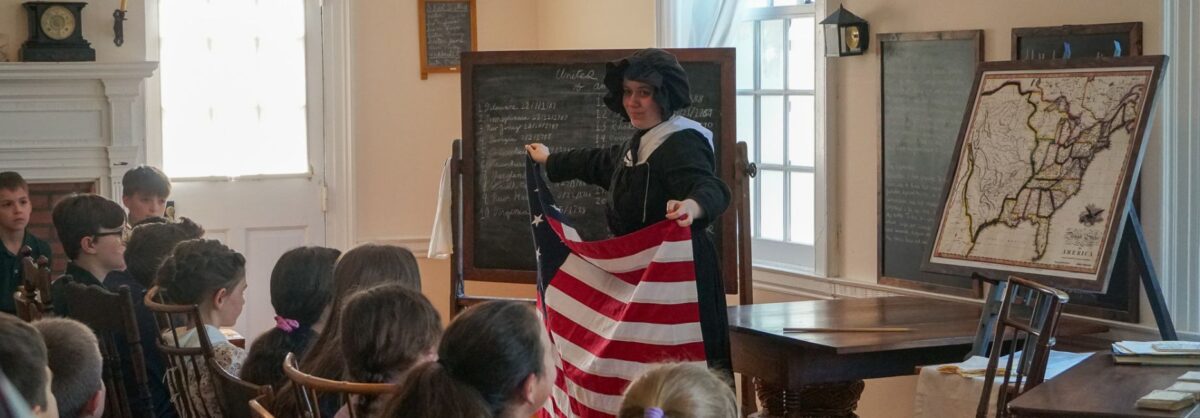
When they exited the bus at the Emmitsburg, Md., Shrine, they stepped into the year 1818 where they encountered Elizabeth Ann Seton’s world, touring her home and the building where she created both the first order of religious sisters and the first Catholic school for girls in the United States. Academy Alive, the Shrine’s popular annual immersive history program, facilitated their time travel.
“It’s phenomenal,” said Portmann said. “Just to have the hands-on experience, especially this immersion where the actors are portraying the roles. It really does come alive.”
She watched her students as they interacted with historical interpreters in period attire, who offered a classroom lesson on the American flag (there were only 20 stars representing states in 1818) and a music rehearsal in the chapel. They even had a conversation with Mother Seton, the first native-born American to be canonized – a timely topic given that the U.S. is celebrating its 250th birthday this year.
“They have been learning about how well disciplined the children of two centuries ago were,” Portmann said. “They have also learned about where Mother Seton came from and what her mission was here — serving the poor, serving the sick, and of course educating.”
Portrait of a Saint
The Corpus Christi school joined other school groups, families and visitors from surrounding areas for the Academy Alive program that ran from April 27 through May 2. More than 1,000 tickets were sold this year, an increase from 884 last year and a steady climb for the last four years. It was the first time the program featured a historical interpreter portraying Mother Seton. The Shrine’s education coordinator Erica Delp was tapped for the role.
“Since Elizabeth Ann Seton was an educator and a pioneer of the Catholic School System, to me, it is pretty important that we offer a dynamic program that inspires students and invigorates faith,” Delp said.
Delp runs the Junior History Interpreter program, which is a part of the Living History Program at the Seton Shrine that is designed train girls between the ages of 9 and 18 in the skill of historical interpretation. She also creates the interpretive content and directs adults who portray the Sisters of Charity who served as instructors at St. Joseph’s School, the school Mother Seton founded and the forerunner of . Joseph’s Academy.
“I wanted to embrace the identity of Academy Alive as our experience for school students, so I have done my best to try to form the program to have school age students learn about life at Elizabeth Ann Seton’s school specifically, rather than just school in general,” Delp said.
This year’s Academy Alive coincided with a new self-guided exhibit in the Shrine’s modern museum, Do the Good: This Sisters Who Shaped America, now open to the public. The exhibit tells the stories of the more than 20,000 religious sisters who trace their lineage back to Mother Seton, showing how they served the needs of the poor and the sick throughout pivotal eras in our nation’s history. Visitors can explore how the Sisters faith and good works shaped and defined education, health care and social services for more than two hundred years, and how the Sisters continue to serve today.
“’Do the Good’” is an example of how Elizabeth and other religious Sisters answered the question: How can I make the world a better place?,” Delp said. “The answer is St. Vincent De Paul’s instruction to ‘Do the good wherever it presents itself,’ which the Sisters took to heart back then. The Sisters and Daughters of Charity continue that theme in their work today.”
“Meeting” Mother Seton
Corpus Christi fourth grader Grace Ramsey enjoyed the interaction with Delp as Mother Seton. “It was very fun,” she said. “She asked us a lot of questions. We got to learn about what life was like back then.” .
Her classmate Edward Barrera added that he learned that St. Vincent De Paul had a great influence on the American saint and her religious community. He enjoyed the entire program, including the outdoor games and walking the Shrine’s expansive grounds “It was amazing because of all the beauty that I saw. It was perfect.”
As the students got back on the bus to return to Chambersburg, they left 1818 behind but took the lessons they learned with them.
“It was really fun. I think the reenactors (historical interpreters) were super kind,” said fifth grader Ireland Zubia.
Portmann added: “It is absolutely inspiring. I feel like grace is just in every nook and cranny. It is a lovely day that God has given us to be here.”