
The ornate and majestic St. Vincent Ferrer Church in New York is widely regarded as one of the city’s most beautiful churches — and it is located just six miles from 8 State Street, where Elizabeth Ann Seton once lived.
The truth is, both saints inhabited a similar world. They both encountered a culture of irreligion, widespread disease, a crisis of spiritual authority, and arguments over the proper relations with Jewish and Muslim believers.
Which is, of course, exactly what we face today.
Vincent Ferrer was born Jan. 23, 1350, the same year the Black Death first appeared in Scotland and Sweden.
The disease would come to take the lives of 50% of the population of Europe, but it was nowhere to be seen in Valencia, Spain, where he grew up, in a city which his family had helped liberate from Muslim rule.
Legends are associated with St. Vincent from the very beginning of his life. When he was an unborn child, the healing of a blind woman was attributed to him; during birth, his mother is said to have experienced no labor pains; and in his childhood, he fasted on Wednesdays and Fridays and gave alms to the poor.
He was ordained a Dominican priest in 1379, a little more than 100 years after the Order of Preachers was founded — disappointing his parents, who hoped he would be a secular priest.
Europe in the 1300s had drifted far from the faith, and St. Vincent met a tough world with a stark motto: Timete Deum et date illi honorem quia venit hora iudicii eius — “Fear God and give honor to him for the hour of judgment is coming.”
His time was filled with disease and famine — along with sexual license, witchcraft, and superstition. Ferrer connected the two in his preaching, becoming, as Pius XII called him, “the Angel of the Apocalypse, flying through the heavens to announce the day of the Last Judgment, to evangelize the inhabitants of the earth.”
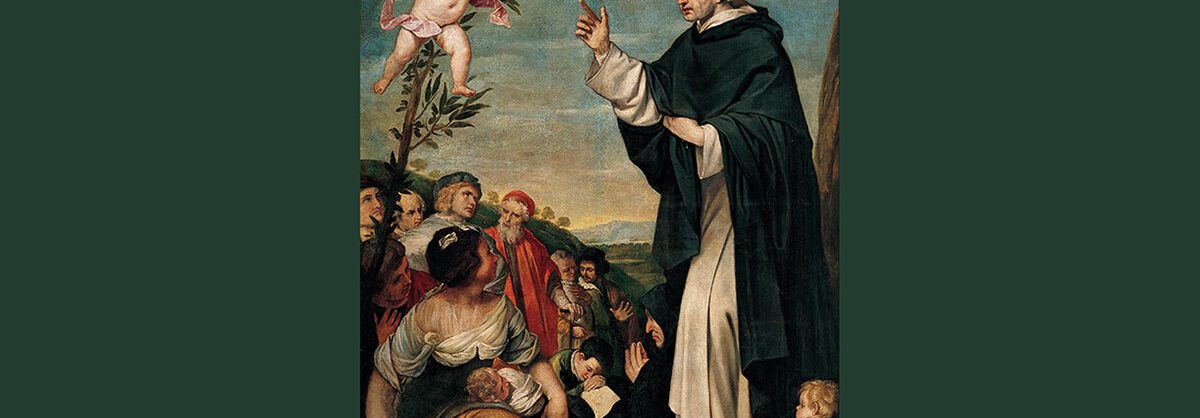
That reference to “flying” was literal. The saint is often depicted in mid-air, because many reported seeing him fly — including interrupting a preaching mission to fly to someone’s aid.
The reference to the Apocalypse was literal also.
St. Vincent Ferrer was convinced the world’s last days had come, and Jesus’s prediction that the sun and moon would be darkened was fulfilled by the eclipse of the faith and decline of the Church.
He warned: “Do penance now, forgive injuries, make restitution of any ill-gotten goods, live up to and confess your religion! If it were certain that in a short time this town was going to be destroyed by fire, would you not exchange all your fixed assets for something that you could take away with you?”
It is reported that he would always preach in his native Spanish dialect, but that his congregations would hear him in their own languages.
Ferrer did more than preach, though. The Dominican was known for his almost routine miraculous cures of people. The Acta Sanctorum, compiled by Jesuits in the 1600s, records 873 miracles of St. Vincent Ferrer, including 70 exorcisms. It also includes 28 instances of him raising people from the dead, attested to by St. Antoninus, archbishop of Florence.
Ferrer cured so many people that he would ask his helpers to ring a bell each time a miraculous healing occurred during one of his missions so that everyone in the Church would know and give glory to God.
His times were also known as a historic low point for the Church.
In the 39 years between 1378 and 1417, the Western Schism gave the Church three claimants to the papacy. It was profoundly confusing, and Ferrer worked for an Avignon antipope instead of the true pope.
The antipope Benedict XIII had been Cardinal Peter de Luna, who ordained Vincent Ferrer a priest. Ferrer was said to have attempted to persuade him to abdicate, but to no avail. Benedict lost his supporters and was declared in schism in 1417.
Ferrer is a model for how to act in a time of confusion. He served Benedict XIII without rancor toward other Catholics, and made Christ’s charity his lodestar instead of church political disputes. He sought to call Catholics back to faith, arguing that the Church was “no longer in the state in which Christ founded it,” but “twisted backwards, to pride, pomp and vanity.”
Ferrer also faced interreligious crises like ours.
Jewish people had long suffered from persecution by Catholics, including forced or coerced conversions. But Ferrer earned the reputation for treating Jewish visitors to his missions carefully and respectfully, healing his Jewish audience members first, and convincing them by his preaching.
He is often credited with gaining 25,000 Jewish converts, and is said to have converted more than a dozen rabbis in Toledo, Spain, such that a synagogue was turned into a church.
He is sometimes accused of being a part of the larger antisemitic treatment of the Jews by Catholics in his day — but that reputation probably comes because of the overzealous activities of some of his converts.
He was also renowned for converting Muslims, sharing with them the good news that God is a loving Father and they were children of God. One story says that when he converted a Moorish king, who then wanted his whole realm to become Christian, until local religious leaders convinced him to send Ferrer away, instead.
In the end, love was at the center of Ferrer’s message.
St. Vincent’s advice for priests describes his own approach. “Your words should sound as though they were coming, not from a proud or angry soul, but from a charitable and loving heart,” he said. “Your tone of voice should be that of a father who suffers with his sinful children.”
Elizabeth Ann Seton was as different from St. Vincent Ferrer as the simple house on State Street is from the magnificent church near Central Park. But, like the two shrines, she is also recognizably doing the same work, in a simpler way: She, too, was dedicated to healing, to sharing the love of Christ, and to religious life.
She wrote:
“To be engaged in the Service of Our Adored Creator, to be set apart to that service … to be placed as a representative of God Himself — to plead for him, to be allowed the exalted privilege of serving him continually, to be his Instrument in calling home the wandering Soul and sustaining, comforting and Blessing your fellow creatures — are considerations which bear no comparison with any other … as the most precious and valued gifts this life can afford.”
That sums up the role St. Vincent Ferrer played in the 1300s — and the role Catholics are meant to play in the 2000s, as well.
TOM HOOPES, author most recently of The Rosary of Saint John Paul II, is writer in residence at Benedictine College in Kansas, where he teaches. He hosts The Extraordinary Story podcast about the life of Christ. His book What Pope Francis Really Said is now available on Audible. A former reporter in the Washington, D.C., area, he served as press secretary for the U.S. House Ways & Means Committee Chairman and spent 10 years as editor of the National Catholic Register newspaper and Faith & Family magazine. His work frequently appears in the Register, Aleteia, and Catholic Digest. He lives in Atchison, Kansas, with his wife, April, and has nine children.
Image: Wikicommons