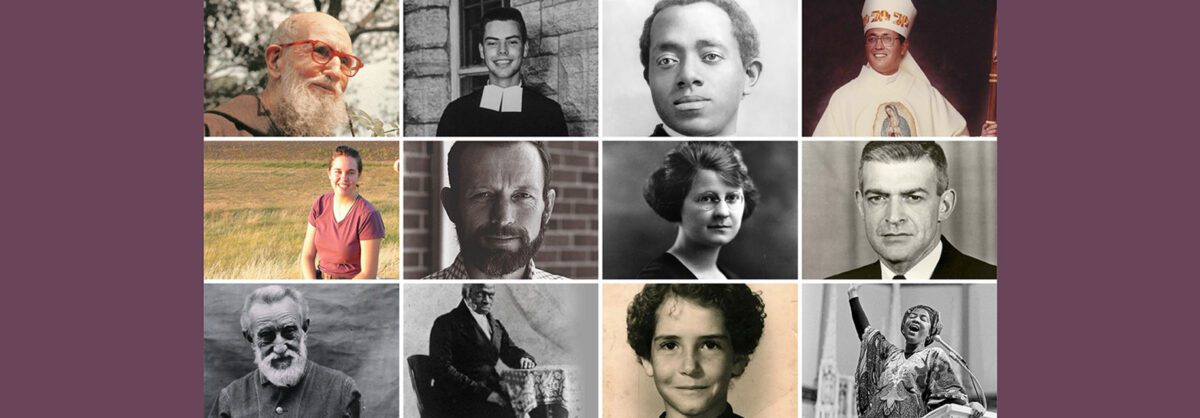

During the Sept. 12–14 celebration of Mother Seton’s 50th canonization anniversary, author Lisa Lickona lectured on the Shrine’s “Saints on Their Way” museum exhibit and emceed talks featuring experts on Americans on the road to sainthood. Along a promenade of booths on the Shrine grounds, members of guilds from more than 20 sainthood causes shared stories, answered questions, and displayed relics for the more than 3,000 attendees. In this reflection, Lickona explores the place American saints hold in her own life of faith.
Our Catholic faith tells us that we are all called to be saints. But — let’s be honest — the lives of many canonized saints often seem more like fairy tales than real life.
Heavenly visions, extraordinary missions, stigmata, and levitations — these all make for powerful drama. But can we really relate to these stories? As much as we love Francis of Assisi, Thérèse of Lisieux, or Francis Xavier, don’t we find the settings of their lives distant and unfamiliar — their stories charmingly romantic, or even fantastic?
I had this feeling for many years. And, to be brutally honest, this unsettled my faith. In the back of my mind lurked the suspicion that the saints’ stories, set long ago in distant lands, were just that — simply stories. They were beautiful legends, meant to edify, teach, or inspire, but certainly not to communicate factual information about how God truly works in the hearts of his friends.
And that thought began to tear down my hope. After all, if God wasn’t truly present in the saints’ lives — as the stories claimed — how could I trust that he would show up in mine?
An invisible wall started to rise up between me and the saints, like the “fourth wall” in a stage play that separates performers from the audience. That invisible wall marks the boundary between the drama and real life. I might love the play, find it engaging and even moving — but I don’t embrace it as life itself. It is, after all, only a play.
But the truth is, the fourth wall is sometimes broken. At an unexpected moment, a performer might step off the stage and address someone in the audience. And what happens then? For an instant, the illusion collapses — the play is no longer make-believe. We feel a sudden thrill: this could be real life!
One of the greatest graces of my life was when the wall separating me from the saints began to crumble. That started about 20 years ago when I began writing professionally about spirituality, and deepened 12 years ago when I took on the task of writing daily reflections on the lives of the saints.
Since then, the saints have stepped off the stage and entered my life in ways I never imagined. And unlike the theatrical fourth wall, this encounter has been unmistakably real. My faith has deepened, my trust has grown. Following the saints, I’ve learned to open my heart to God’s love — and day by day, that love becomes more and more the substance of my life.
From the moment I began working with the saints, I discovered they were real people—with real problems, insecurities, and challenges. Some lived long ago and far away, it’s true, but many lived in times and places close to my own. These are the American saints. And as I got to know them, I came to see that their intimacy with God was not something to dismiss or romanticize. It was concrete, credible, and deeply relevant to my own journey.
One of the first American saints I came to know was Blessed Solanus Casey. In the early 2000s, while living near Detroit, I met someone who knew a person healed of a serious illness through then-Father Casey’s intercession. Casey had lived and served and miraculously healed people just 40 miles from where I was living. I got in my car and drove to the shrine built in his honor. I prayed at his tomb and heard more stories from those who had known him. That day, I discovered I was just two degrees of separation from the humble Capuchin friar who spent his nights in prayer and his days working miracles. This happened in my place, in my time — and a thrill ran through me.
Solanus Casey was the first of the modern American “saints on their way” who stirred my desire to meet Jesus in my own life and taught me how to open myself to prayer. Soon, I came to know others.
Servant of God Dorothy Day lived the vulnerable life of a single woman in New York City, converted after the birth of a child out of wedlock, founded the Catholic Worker movement, and wrote prolifically.
Blessed Stanley Rother grew up on a farm in Oklahoma, studied for the priesthood in Emmitsburg, Maryland — just up the road from the Seton Shrine — and went on to serve the indigenous poor in Guatemala. There he laid down his life for Christ, becoming the first American-born martyr.
Servant of God Walter Ciszek was the son of Polish immigrants in Shenandoah, Pennsylvania. He became a Jesuit missionary to Russia, where he spent twenty years imprisoned in Soviet labor camps. After returning to New York, he became a spiritual director to laypeople and wrote the profound memoir He Leadeth Me.
And—oh yes!—Servant of God Thea Bowman! At just fifteen, she left her home in Yazoo, Mississippi, to become the first Black woman to join the Franciscan Sisters of Perpetual Adoration in La Crosse, Wisconsin. A liturgist, scholar, and joyful prophet among Black Catholics, Thea embraced her African heritage in song, speech, and dress—once bringing a gathering of American bishops to their feet.
These men and women captivated me. They convinced me: holiness is not a fairy tale or the stuff of legend — it is possible, here and now. Through them, sainthood became real for me.
That’s why I was overjoyed to join the Seton Shrine on Sept. 12-14 for the 50th Anniversary of Elizabeth Ann Seton’s canonization. That weekend, the Shrine hosted more than twenty guilds devoted to the causes of American men, women, and even children on the road to sainthood. As emcee of the “Saints Stage,” I had the pleasure of wandering through the “Saints Village,” a promenade lined with booths where guild representatives told stories and answered questions about these future saints. I filled my pockets with holy cards and medals, kissed relics — and best of all, heard unforgettable stories from those who knew them best.
On the “Saints Stage” that day, author Kevin Wells told the story of Father Aloysius Schwartz, whose lifetime of missionary service in Korea was inspired by a comic book he read as a boy.
Father Dan Mode, a Navy chaplain, recounted how he uncovered the heroic life of Servant of God Father Vincent Capodanno, the “Grunt Padre” who died ministering to soldiers in Vietnam.
And three talented young women performed dramatic monologues, bringing to life Servants of God Charlene Richard, Michelle Duppong, and my beloved Thea Bowman — complete with singing and dancing!
For me, that day was like a little piece of heaven — a chance to encounter amazing friends all over again. I rediscovered what makes these people like us, and it rekindled my hope that we can be like them.
If you haven’t yet come to know these “Saints on Their Way,” I invite you to begin the adventure.
Explore their stories at setonshrine.org/saints-on-their-way, and through the websites and online videos devoted to their causes.
And then — let these friends of God befriend you. Let them shatter the invisible walls!
LISA LICKONA, STL, is Assistant Professor of Systematic Theology at Saint Bernard’s School of Theology and Ministry in Rochester, New York, and a nationally-known speaker and writer. She is the mother of eight children.