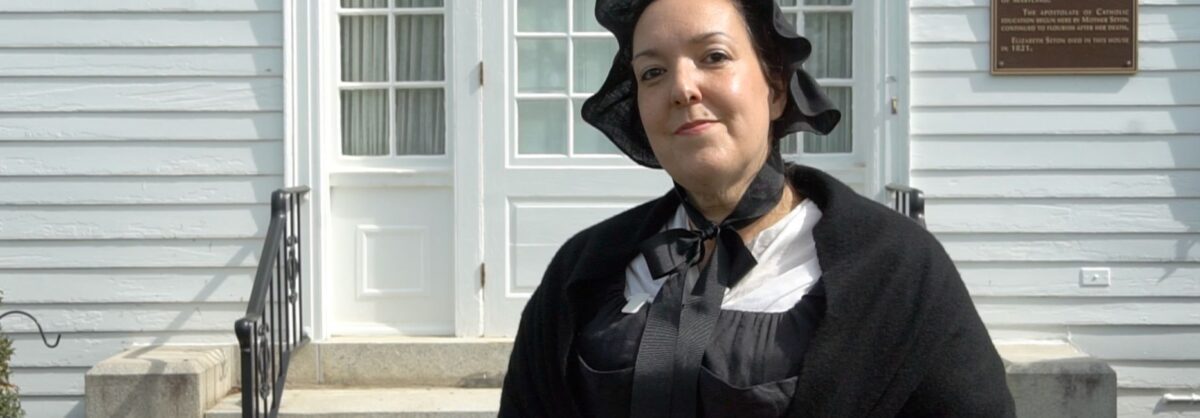

Erica Delp found the National Shrine of Saint Elizabeth Ann Seton almost by accident.
She was active in historical interpretation and a committed Christian who happened to visit the Shrine’s Living History Program with her young daughters on an outing.
“When I saw the program, I was like wow, to be able to do this from a faith-based perspective, teaching about the life of someone who made such a significant impact on people,” she said. “It was the perfect marriage of what I wanted to invest myself in doing.
“It was a spiritual lift, a wake up that day.”
Years later, Delp is the educational programs coordinator at the Shrine overseeing a range of popular activities aimed at showcasing for all ages the life and legacy of Mother Seton, who is the first native-born American to be canonized a saint.
Delp, who entered the Catholic Church in 2024, will take on a special role this year as she portrays Mother Seton for the first time during the Shrine’s annual Academy Alive program that runs from April 27 to May 2. The program, which attracts hundreds of elementary school students each year for historical and faith-filled activities, will have a special focus on America250 and the early years of the nation.
Delp recently talked about her experiences and why Mother Seton remains so relevant today and what it’s like to portray one of the most important figures in the history of the Catholic Church in America.
Q: What did you learn about Mother Seton that first day?
A: What I saw in Mother Seton was hope. I was just a younger mother at that point and my kids were in that coming out of the really little kid phase. I had spent a lot of years slogging through the day to day and doing dishes and, you know, all the things that go along with motherhood, keeping them safe, trying to teach them, and I began to wonder what God is going to do with all of this in conjunction with all the other things that had been a part of my life.
I looked at Elizabeth Ann Seton, and I saw in her that God took all the things, and he brought them together in a way that brought the ultimate best out of it. It was the encouragement that I really needed at that point in my faith and in my personal journey to know that there was not going to be any wasted things. He did it with Mother Seton, so why couldn’t He do it again with me?
Q: How does Mother Seton’s life resonate with younger people?
Elizabeth Ann Seton was very human, when she was young, she didn’t always want to study. She wanted to do things that girls would want to do like run off into the woods and have fun in the fields or slip out of her classroom so she could go say hello to her father who she happened to see on the street.
She was a kid just like them, but because she learned how over time to see promise in the small things and be faithful in the good that was put before her to do in a given day, God took that and did great things with it.
What would have happened if Mother Seton had given up on studying French and music? What would have happened if she had not copied things into her commonplace book? She couldn’t have taught her own children. She wouldn’t have been a teacher. She wouldn’t have been a mother of a religious community. But because she was faithful in the small things, God multiplied that and made something that had a very lasting legacy that is still going on today.
And that can be what God does in somebody who is a kid sitting on the rug of the sitting room when they come to our Academy Alive program this year.
Q: How does one prepare to play the role of Mother Seton?
A: First, you need to spend time with her, to pray at her tomb and then ask the Holy Spirit to inspire you on what needs to be said and what needs to be shared.
Of course, you also need to think about what you want to say to people because it is impossible to say everything. Her life was huge, and we very thankfully have a lot of resources in primary sources and biographies, and, accounts others wrote of her. You need to know the basic facts, but also her personal points of view on certain things, experiences she had, perspectives she holds.
The next step that I’m trying to work on right now is just trusting that that will be sufficient and that whatever happens, even though it won’t be perfect, that it will be what God intended and that people will gain something good from it.
Q: As a historical interpreter, what about her life speaks the most to you personally?
A: That the human experience is not free from suffering. My experience has not been free from suffering and no one’s is. I think the place that I most personally connect with her is in how she handled that pain.
She could have gone in so many different directions but instead of shutting down, instead of closing up, instead of getting bitter, instead of getting angry, she allowed God to be present with her and to grow to a point where she could be present with others, whether it was a child and offering a smile and an encouragement or sitting at a deathbed with someone.
She continues to show me what I want to shoot for.
Q: Are you prepared for children who try to stump you?
A: Oh yeah, actually we practice for that. They mostly want to know a lot about daily life. They want to know where you sleep and what you eat and how do you do math and things like that.
We’re ready to have fun with those sorts of questions that will mean a lot to the kids and that will help them know she was a real person.
Q: How meaningful is it to play Mother Seton during America250?
A: I’ll just say that I am a Daughters of the American Revolution member and a Daughters of the Union Veterans of the Civil War member too, so in my spare time, you will see me out in either my colonial or Civil War attire, educating the public about our great nation because I’m so proud of what my ancestors did.
No country is perfect, and ours has plenty of problems, but when you look at how it came to be, you see that its future is still worth investing in through what we choose in our day-to-day.
When it comes to Elizabeth Ann Seton, she grew up and lived in a time and place that was influenced by structures of governments and world events like wars. She lived through all of that with grace and a testimony and was able to respond to human needs that resulted from those times.
I think that’s where we find her in America – the fact that she was making America a place that people might actually want to live. That’s her place in American history, but besides that, she’s transcendent. She happened to be in America, but I think no matter where God would have put her, she would have been focused on building His kingdom.
That is how she lived her life, and we can’t lose that in the story.