
EMMITSBURG, MD (March 17, 2026) – In 1809, long before Elizabeth Ann Seton became the first native-born American to be canonized, she founded the Sisters of Charity of St. Joseph’s in this small Maryland town, the first community of religious women established in the United States. But the work was just beginning.
In 1862, Sr. Anthony O’Connell helped pioneer battlefield triage while caring for wounded soldiers following the Battle of Shiloh. During the 1918 influenza pandemic, Sr. Josella Conlin mobilized dozens of sisters to care for sick troops at Camp Zachary Taylor. Decades later, Sr. Mary William Sullivan of the Daughters of Charity, worked alongside civil rights leaders in Chicago, transforming a neighborhood settlement house into a force for community empowerment.
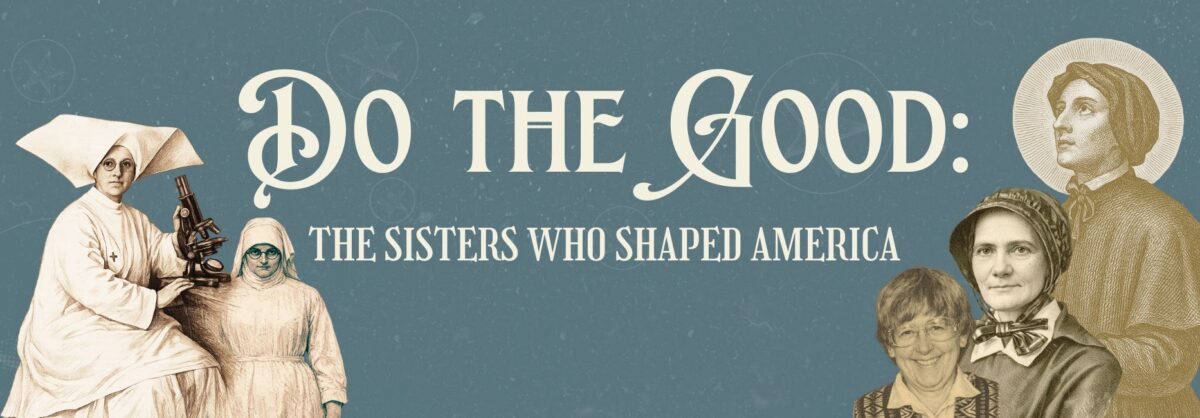
These are just a few of the stories featured in “Do the Good: The Sisters Who Shaped America,” a special exhibit opening March 19 in the museum at the National Shrine of Saint Elizabeth Ann Seton in Emmitsburg. The self-guided exhibit is dedicated to telling the stories of more than 20,000 religious sisters whose orders trace their lineage to Mother Seton. The exhibit explores how these sisters, following Mother Seton’s example, served the poor, responded to crises and helped shape education, health care and social services across the United States for more than two centuries and up to the present day.
Organized around key periods in American history, the exhibit begins in the early years of the American republic and follows the sisters’ work through the Civil War, when they served as battlefield nurses and into the twentieth century, when they cared for the sick during pandemics, expanded nursing education and responded to the challenges of industrialization, immigration and global conflict.
“The stories in this exhibit remind us that the charitable work Mother Seton began is still unfolding,” said Rob Judge, executive director of the Seton Shrine. “The women featured in this exhibit responded to the challenges of their times — war, disease, poverty and social change with love and compassion. Their example reminds us that the call to serve Christ in the poorest among us through direct, personal service, does not end with them. It continues in every generation, inviting each of us to carry that spirit of service forward.”
In recent decades, the sisters’ work has continued to evolve. Their ministries include global missions, health care innovation, advocacy for civil rights and outreach to communities affected by poverty, illness and displacement.
The opening of the exhibit on March 19 will include a ribbon cutting at 11 a.m. that will feature remarks from Sr. Regina Bechtle, SC, Sisters of Charity of NY, which donated many of the artifacts in the Shrine Museum, along with Barbara Bozzuto of the National Leaders Council of the Seton Shrine and Robyn Kress, president of the Ascension Foundation and a member of the National Leaders Council.
Ascension, one of the largest Catholic health care systems in the U.S., and which continues the sisters’ work in health care, is the presenting sponsor of the exhibit.
Sr. Regina Bechtle said: “The Sisters and Daughters of Charity have served people from the whole panorma of languages, colors and cultures that make up these United States of America. Each served with humility. Each served with simplicity. Each served with charity. These are the hallmarks of every Sister and Daughter who is featured. Each symbolizes hundreds of others – equally unique and diverse. Their contributions to this nation and its well-being cannot be measured.”
Bozzuto recalled her witness of to the mission of the sisters as a board member and chair of Ascension St. Agnes Hospital in Baltimore, whether the Daughters have been casing for residents since 1823.
“I was witness to the daily gift the Daughters offered their patients: understanding the sickest patients as God’s children without judgment, offering succor and love to the most vulnerable, taking care to assist new mothers, sometimes very young or ill,” she said.
Kress noted that the Shrine and the Museum stand on “holy ground.”
“The legacy of Saint Elizabeth Ann Seton is not a static piece of history,” she said. “It is a living, breathing movement. Mother Seton provided a blueprint for fearless charity. Her actions proved that one woman’s ‘yes’ to God could kindle a fire of service that would shape the fabric of our nation in the says you see through the exhibit and laying the foundation for the Catholic health systems that serve so many today.”
Mother Seton and America250
“Do the Good: The Sisters Who Shaped America” is part of the Shrine’s broader America250 initiative, a yearlong series exploring how Mother Seton’s life and legacy reflect the nation’s early identity and ongoing development.
Additional programming in 2026 includes a renewed focus on pilgrimages and continued promotion of the “Saints on Their Way” initiative. The Shrine also continues to build support for its $50 million endowment campaign, designed to ensure the site remains a vibrant place of faith and history for future generations.
These initiatives build on the Shrine’s existing programming, which includes “Seeds of Hope” retreats for the poor; the annual Sea Services pilgrimage; the “Back from the Dead” cemetery walks, the spring living history program, Academy Alive; and tours of Mother Seton’s historic homes throughout the year.
The exhibit will be free and open to the public every day from 10 a.m. to 5 p.m. through spring 2027. The exhibit is designed for individual visitors, families, educators and groups. Advance reservations are recommended for school groups, parishes and other organized visits.
Mother Seton: An American Story
Elizabeth Ann Bayley was born in New York City on August 28, 1774 to a prominent Episcopal family. Her father, Richard Bayley, was a New York physician and the first chief health officer of the city. In 1794, she married the wealthy businessman William Magee Seton, with whom she had five children. As a couple, the Setons socialized with Alexander and Eliza Hamilton and other well-known political and business leaders of the era.
Eventually, William Seton’s business crumbled and he developed tuberculosis. In an attempt to improve his health, he and Elizabeth sailed to Italy, but he died there in 1803. After discovering Catholicism in Italy, Elizabeth Ann Seton returned to the United States and entered the nascent Catholic Church in 1805 in New York.
After some difficult years, she moved to Baltimore in 1809 at the invitation of Archbishop John Carroll, America’s first bishop, who urged her to start the first free Catholic school for girls in Emmitsburg. He also approved her founding of the Sisters of Charity of St. Joseph’s the first community for apostolic religious women established in the U.S. Mother Seton died in 1821, and in 1975 she was the first native born American to be canonized a saint in the Catholic Church.
For more information about the Shrine, please visit setonshrine.org.
The National Shrine of Saint Elizabeth Ann Seton
The National Shrine of Saint Elizabeth Ann Seton in Emmitsburg, Md., is a place of God and of history, where 70,000 visitors a year walk in the footsteps of a saint. The Shrine offers pilgrims prayerful comfort from Mother Seton’s story and her intercessions as a friend in heaven. It is an active Basilica and has a wide range of historical buildings and programs that show what life was like when Mother Seton lived here more than 200 years ago. It was here that she founded the first community of religious women established in the U.S., created the first free Catholic school for girls staffed by sisters in the U.S. and fulfilled her mission of serving those in need. Today, her legacy includes several religious communities with thousands of sisters, who serve others through schools, social service centers and hospitals throughout the world. She was canonized in 1975. Her remains are entombed at the National Shrine that bears her name. For more information, please visit https://setonshrine.org/.
# # #